Swedes have long rejected the euro. But sentiment is changing due to the geopolitical situation and joining the eurozone could happen soon, writes "Frankfurter Rundschau".
More than 20 years after the Swedes voted in a referendum on the euro and decided that they did not want to take this step, the situation has changed significantly. Back then, the answer was "No, thank you", but it could soon be "Yes, please", writes the German "Frankfurter Rundschau".
In the middle of last year, the country's former Prime Minister Göran Persson said that joining the eurozone was inevitable for Sweden. According to him, this could even happen very quickly. The reason - the global international crisis in which the world is currently located. "We will adopt the euro when we realize that the Swedish krona does not work in the open global economy."
The advantages outweigh the disadvantages
In the referendum held in 2003, 56 percent of people voted against adopting the euro, and 42 percent were "for". However, both the world and the Swedes have changed since then. At the end of last year, economist Professor Lars Kamfors published a report in which he described Stockholm's readiness to join the eurozone now and concluded: "The advantages outweigh the disadvantages". He was among the experts who, when Sweden joined the EU, recommended not adopting the euro.
Membership in the eurozone will lead to increased cross-border trade and foreign investment, and Sweden will gain greater influence in Brussels regarding the development and integration of European capital markets, Kamfors believes. On the other hand, the risk that high government debts in the eurozone will lead to costs for Sweden will increase. Russia's attack on Ukraine has already made Sweden rethink its position on the North Atlantic Alliance and join NATO and has increased the importance of deeper integration into the European Union, the expert quoted by "Reuters" says.
The main factor - deeper connectivity with Europe
Assessing the advantages of greater or lesser fiscal and interest rate independence, participation in the costs of international crises, etc., the professor from Stockholm University draws attention to something important. "My main motivation for recommending the adoption of the euro is Sweden's contribution to deeper political connectivity in Europe in an increasingly threatening geopolitical situation", says Kamfors.
Almost only pro-European voices are heard from business circles, writes "Frankfurter Rundschau". Peter Magnus Nilsson, head of the industry-funded think tank Timbro, points to the “economic destabilization” being carried out by the Trump administration as a prerequisite for Sweden. He argues that having a freely floating national currency at the moment is “internationally unusual and extremely risky” and that the Swedish krona has been weak and unstable for years anyway. The euro, on the other hand, has weathered several crises and remained stable. A “freely floating” currency means that the exchange rate is determined by supply and demand in the foreign exchange market.
Sweden’s 10 million inhabitants, home to big companies such as Volvo, IKEA and fashion giant H&M, are preparing for a renewed debate about joining the eurozone at a time of general uncertainty. Although the Swedish krona’s decline has now stopped, it has been that way for several years. Experts believe that the reason is Russia's full-scale war against Ukraine. The country's chronically weakened economy has led to 25 percent youth unemployment. Another factor is the bankruptcy declared by electric car battery manufacturer Northvolt.
Elections could provide a boost
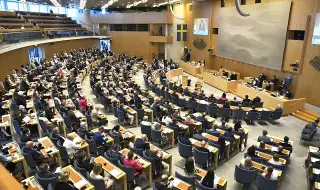
There is no doubt that the EU will accept a potential decision by Sweden to join the eurozone much more smoothly than was the case with Bulgaria. However, it is not clear how and when a discussion on the topic might be initiated in the parliament in Stockholm. Sweden is due to hold parliamentary elections this September, and according to polls so far, the opposition Social Democrats could oust Prime Minister Ulf Kristersson's Conservative Party. He has long supported Sweden's accession to the eurozone, but his minority government depends on the votes of the nationalist Sweden Democrats, which is categorically against it.
Social Democrat Magdalena Andersson, who has the best chance of winning the elections this fall, has not commented on the topic. According to Peter Magnus Nilsson of the Timbro think tank, however, it is precisely a Social Democrat government that could start the process of joining the common European currency. "Sweden joined both the EU and NATO under Social Democrat governments and during crises. The same could happen with the euro," Nilsson told the "Frankfurter Rundschau". In his words, this would show that "there is a future and a world that do not depend on Donald Trump's mood on a particular day".