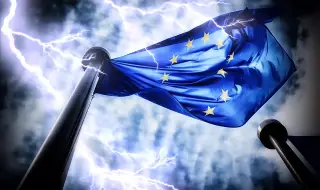
The European Union has always prided itself on its members moving forward together, as one. That era is over.
At a meeting in a castle in eastern Belgium on Thursday, the leaders of France, Germany, Italy and other countries backed plans - which will be fleshed out at a European Council meeting next month - for individual groups of countries to unite and join initiatives in a narrower format. Governments have spoken of a sense of urgency as Europe's competitive edge erodes and many of its ideas are bogged down in endless hesitation and disagreement.
"We must act quickly", said French President Emmanuel Macron, appearing to put his recent spats with his German counterpart to the back burner as both insisted the EU must adopt policies to boost economic growth.
Shaken by a series of geopolitical crises, the union is beginning to realise that it cannot respond adequately if it acts only when all 27 member states agree. From defence to energy and investment, the European Commission — which draws up the rules — and national governments — which must implement them — are finding themselves constrained. Meanwhile, businesses complain that they are being suffocated by bureaucracy and high energy costs.
Donald Trump's threats to annex Greenland and his hesitations about supporting Ukraine against Russia, as well as China's strategy to flood Europe with artificially cheap goods, have given additional impetus to top European leaders to take action.
Thursday's summit - just 15 kilometers from the Dutch city of Maastricht, where one of the EU's founding treaties was signed in 1992 - has become a "strategic brainstorming session" on how to "boost prosperity, create quality jobs and ensure accessibility", said European Council President António Costa.
"Today's discussion brought new energy and a shared sense of urgency around this goal," he added.
At the next meeting in Brussels, European Commission President Ursula von der Leyen will present what she calls the "One Europe, One Market Roadmap and Action Plan", including reforms such as reducing administrative burdens and mobilising private and public capital to help European start-ups scale up. Leaders will vote on the plan before the summer.
If agreement is not reached on some areas between all 27 countries, the EU will resort to the mechanism of "enhanced cooperation" - smaller groups of countries that make faster progress on certain policies. While the idea has been supported before, it has often been shunned and described as divisive.
"Talking about enhanced cooperation could be a motivating factor to get more countries on board," said a European diplomat who spoke on condition of anonymity. Few capitals would want to back down from measures that boost prosperity, even if they have reservations about some aspects of them.
German Chancellor Friedrich Merz said that two or three years ago, such a conversation would not have been possible. "We are facing a completely new geopolitical situation and we are ready to deal with it. But Europe will only be able to stand its ground if it is competitive."
One area where "enhanced cooperation" could be used is the Savings and Investment Union—the EU's ambition to create a capital market similar to the US. The commission is proposing a European equivalent of the Securities and Exchange Commission, but this would require agreement from countries including Ireland and Luxembourg, which have so far been hesitant to give up their powers.
The roadmap would set measurable targets in areas such as telecoms, capital markets, services and energy, which von der Leyen wants to be implemented by the end of 2027.
The first proposal would be the so-called "28th regime" — a new European corporate regime friendly to startups, which is due to be presented on March 18. It would allow companies to register entirely online within 48 hours and make it easier for them to expand across borders.
According to participants in the talks, agreement was reached on four key areas: unlocking Europeans' savings for investment in strategic companies; tackling high energy costs, including by reviewing debates around the Emissions Trading Scheme; continuing to conclude trade agreements to diversify dependencies; and greater support for European priority in public procurement - the so-called "buy European" policy championed by Macron.
It was the last point that was among the greatest successes of the meeting, with leaders giving the Commission a mandate to draw up a sectoral list of dependencies in which European companies could receive preferential treatment to support key industries such as automotive and pharmaceuticals.
However, tensions were not absent. Even before the meeting, disagreements emerged between the major economies and the rest of the countries. France and Germany have taken different sides of the "buy European" debate, and there have been disputes over how far the single market should go.
A preliminary meeting of 19 leaders - excluding Spain, Ireland, the Baltic states and Slovenia - showed the selective nature of the discussions. Some of those invited were late, and the meeting began without Merz, Meloni and Macron.
Disagreements also emerged between the countries and the European Commission. Germany and Italy insisted that the EU "restrain" itself in creating new regulations, while Von der Leyen blamed national rules for some of the industry's problems.
Nevertheless, Macron left the meeting with a smile, demonstrating harmony after the rapprochement with Germany. Asked if he was now good friends with Merz, he laughed: "Yes, always."