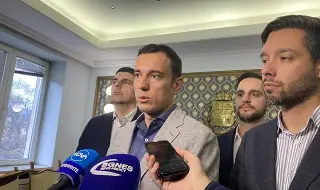
"Creating a problem so that the "savior" can come and solve it" - this is how the majority in the Sofia Municipal Council works, Vasil Terziev told DV. However, the lack of dialogue only contributes to the problems, the opposition responds.
Do you remember what happened last year before the matriculation exams? A transport blockade in Sofia, which created a heart-breaking situation for hundreds of families who did not know whether the matriculated students would arrive on time for the exams. After Boyko Borisov publicly called on the state to provide the missing funds to increase salaries, about 15 million leva were allocated, the illegal transport blockade was stopped and the topic was dropped from the agenda.
According to many, this was a textbook political action, which aimed primarily to show the "muscles" of GERB - "we are the ones who deal with crises, and you are incapable". Thus, the problem was not only not solved, but also deepened and began to float like a loose mine in the space of the mayoral administration. Because these funds must be found every year.
This year, at the beginning of the month, the unions again stated that protests by public transport workers were being prepared.
The crises in Sofia follow one after another and are often of a highly political and pre-election nature. Can the mayor solve them?
"The possibilities for theft are enormous"
Let's remember: in the summer of 2024, the boards of all transport companies were replaced without a competition. With temporary management. Thus, following the model of "permanent temporary appointments", which make "permanent temporary decisions", these companies function to this day. The transport companies are subordinate to the Municipal Council, in which the councilors from the so-called economic majority - GERB, ITN, BSP, VMRO and breakaway parties - are actively blocking attempts to have an external audit that would examine the companies' business, the condition of the fleet, the cost of their various activities, in order to make a plan on how to optimize their work.
"Hundreds of millions pass through commercial companies, the opportunities for theft are enormous", Boris Bonev, chairman of the "Save Sofia" group in the SOS, told DV. He continues: "GERB holds the economic majority. If it supports the numerous demands that we from "Save Sofia", and PP-DB, and Vanya Grigorova, and "Vazrazhdane" have made, things can quickly get better. My feeling, however, is that the "evil forces", if I may call them that - Krasyo Cherniya, Orlin Aleksiev, Taki, Madjo, Valka - all these people with nicknames who manage the agenda and finances of municipalities in Bulgaria, saw that there was no pilot in the plane, saw that the people who want the thefts to stop are a minority, and they waved their horses like never before. There must be real synchronization between the mayor and those groups and municipal councilors who want this to change. There must be dialogue, and there is none. This is politically illiterate and infantile”.
According to Mayor Vasil Terziev, when we talk about the problems of transport in the capital, one of the most important questions is when fair competitions will be held so that qualified people with a mandate to manage and make reforms will come to the companies. The goal is to end the practice of outrageous contracts, to save money on commissions, leaks, and bloated administration, he says. "Protecting the public interest does not mean buying 20-year-old buses for 100,000 euros. We have shown that for just over 100,000 euros, you can buy the most modern Mercedes, which currently serve lines in Vienna... And the saved resources can be redistributed for salaries and working conditions."
"There has never been such a confrontation"
Where will this money come from, however, since the framework in which the city operates has a deficit of tens of millions of euros?
"The first option is to raise the price of transport documents,", the mayor of Sofia answers. "Nobody wants to do it. Because it is an unpopular measure. Option two: the parking reform and expansion of zones in Sofia, which was supposed to come into force, but has been temporarily suspended until the final resolution of the dispute. Option three: directly from the municipality, which should not be at the expense of other sectors. You cannot always cut capital expenditures that secure the future of the city, and the funds go to salaries."
However, the mayor does not know what the salaries are in these companies. The municipality, which provides the money, has no information about what amounts the board members distribute among themselves, Terziev complains. "There are obvious anomalies. It is said that the chief accountant of the transport department takes significantly more than the chief accountant of the Sofia Municipality, whose signature is used to sign all the billions with which the city functions. And this is not fair."
He claims that "there has never been such a confrontation between the mayor on the one hand and the municipal council and the state". "I don't mind being criticized for bad ideas. But destroying and burning everything to prove that your opponent is "incapable" is extremely wrong," believes Terziev.
Do Sofia residents know that the important decisions are made by the SOS?
There are 24 district mayors in Sofia, elected by local residents. They have their own administration, a different agenda. In this complex system with a multi-billion dollar economy, there are 3,000 people in the central and district administrations, plus another 15-20 thousand in companies.
Vasil Terziev says that the blame for every problem, however, is shifted directly to the mayor. According to him, people have been deliberately kept away from the management processes of their city, from understanding the mechanisms in the system and from knowing that the Sofia Municipal Council (SMC) is the collective body that makes the most important decisions.
It is the SMC that is responsible for appointing the boards of directors of commercial companies - electric transport, road transport, metro, urban mobility center, district heating, markets, hospitals, as well as voting on the capital program, approving the budget, determining the economic framework of transport, etc.
Terziev claims that since he took office in 2023, Sofia residents have seen that the system is built like this - "creating a problem so that the "savior" can come and solve it."
Problems with communication and staff selection
However, is this really the case? The criticism of the mayor is that he makes communication mistakes - both in the dialogue with citizens and with the state. The disagreements in his team, from which the tenth deputy mayor has resigned, are seriously impressive.
According to Boris Bonev, the bigger problem than the tenth resignation, the "inevitable chaos that occurs with the turnover of people", is that key projects that depend on coordination between different units are stalled. "When the new person arrives, until he gets into a rhythm, until he understands what is a priority, what is not - the mandate ends! Large processes cannot be brought to the end, because every month a new person appears. This creates stress in the administration and shows a lack of direction”.
"There are many reasons for a person to leave an organization, Terziev explains. "I have always wanted to create a machine in which none of us are indispensable", he adds.
The mayor of Sofia still believes that the successes are visible: "If a person is open-minded and looks at the annual reports, he will see that more things happen every year, they happen better, faster. Despite the active opposition from the state.”
However, a team is built with mutual trust. And turnover does not speak of successful selection of people. The frequent change in the mayor's team calls into question the stability of the government. "The restructuring process cannot be done extremely unprofessionally. Yes, it was absolutely necessary to carry out a reform, but it matters how you do it. It is also important to have a humane attitude towards people. This casts doubt on the completely false narrative that Terziev is a good manager,” claims Boris Bonev.
"It takes time to get where we are and to assemble an exceptional team of people. Because there are not many who are ready to come, to work decently for not much money, given that at any moment the yellow-brown media machine can comment on their children, their partner, their business", says the mayor of Sofia. "I didn't expect it when I entered this office. I didn't know what it was like to be in a constant battle with the Municipal Council and the state. You can't know this in advance.”
The big tasks facing the mayor of Sofia
The problems in Sofia's transport are not just transport problems. This is a political test. The possibility of blockage is a tool for pressure. Crises appear at precise moments, often with an election horizon.
This is just one of the tasks that the mayor of Sofia must solve. The other is communication. For now, decisions are being postponed.