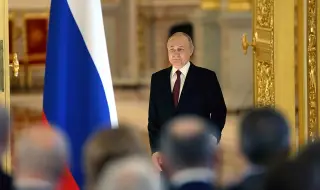
Russians' trust in Putin has been falling for the seventh week in a row. Approval for his work has fallen to 65.6%. Why? And what does this mean for Russia?
Almost a quarter of Russians (24.1%) do not trust the country's President Vladimir Putin, according to new data from the state sociological institute VTsIOM. According to the survey, conducted between April 13 and 19, approval for the Russian president's work has fallen by 1.1 percentage points to 65.6%, and trust in him - to 71%.
The decline has continued for the seventh week in a row - At the beginning of the full-scale war against Ukraine, 71% approved of the president's activities, and 86.1% personally approved of him.
At the same time, support for the government and Prime Minister Mikhail Mishustin is falling, although the rating of "United Russia" is slightly increasing.
The false state methodology
These data contradict the observations of another state service – the – Public Opinion Foundation, which does not report a deterioration in Russians' attitude towards the president. According to them, Putin's approval rating is at around 76%, and trust – about 74%.
The publication "Meduza", citing a source in a media outlet loyal to the government, reported that the presidential administration has recommended that Russian media outlets focus on the "Public Opinion" figures or avoid mentioning ratings altogether.
Putin's real approval rating may be even lower than the VTsIOM or "Public Opinion" data, believes political scientist Abbas Galyamov. In an interview with DW, he emphasized that even the existing VTsIOM indicators are formed by questions in which the president's name is mentioned. In the conditions of repression and state propaganda, the surname Putin can have a psychological effect on respondents, he specifies.
In this regard, Galyamov draws attention to another question from the survey, which does not include Putin's name, namely: "Which politician would you entrust with solving important state issues?". Two-thirds of Russians do not say that they trust Putin, and to this same question in 2015, i.e. at the peak of his popularity, over 70% of Russians indicated the name of the Russian president.
Galyamov does not rule out that Putin is not aware of the low level of support for him, since in the system of power "no one would risk throwing his rating in his face". But even if he knew about the negative trend, it would hardly change anything, because that is his political style, the political scientist believes.
Does the war no longer mobilize Russians?
In the current Russian realities, it is not the specific figure that is important, but the negative dynamics, political scientist Dmitry Oreshkin is convinced. The expert points out that "sociology in an authoritarian regime and sociology in a free regime are two different things". According to him, it is the dynamics that point to a sustainable decline. He refers to data from the "Levada" center: if in 2025 about 75% of respondents believed that the country was going in the right direction, now they are about 60%. "The downward trend is reported by all sociological services," the political scientist specifies.
Oreshkin connects the reason for the drop in ratings with the change in the perception of the war. According to him, it used to provide the government with a mobilization effect, but now it is no longer functioning as a drug. For the first time in 25 years, this mechanism has stopped working: "He cannot start another war, because it will no longer please anyone", says the expert. Socio-economic problems are coming to the fore, and the accumulated fatigue of society is manifested in increasing irritation and decreasing support.
Various media outlets are suggesting that, against the backdrop of the decline in the rating, the Kremlin may soften its tough approach a little - for example, with regard to restrictions on the Internet. According to information from the publication "Verstka", there is discussion of reducing political pressure on social networks - at least until the parliamentary elections, which will be held from September 18 to 20 this year. Internet restrictions in Russia are being coordinated by the Second Department of the FSB, which is believed to be responsible for the poisoning of politician Alexei Navalny in 2021, The Bell reports.
However, judging by Putin's recent statement, we should hardly expect any more serious concessions in this regard, as the authorities justify Internet outages in large cities with the need to prevent terrorist attacks.
What do political scientists expect?
According to Galyamov, the decline in popularity can be compensated by strengthening the reliance on the power structures. According to him, such dynamics increase the risks of internal destabilization: a situation in which the power elites begin to feel like independent political players can lead to attempts to redistribute power, even reaching coup scenarios. The power structures will want to seize even more spheres of influence by placing their own people there, the political scientist does not exclude.
Dmitry Oreshkin specifies that the government has maintained stability for now, but in the long term, "improvements are simply not to be expected", and any additional crises can intensify the already outlined negative trend. Against the backdrop of the prolonged conflict, socio-economic issues are once again coming to the fore – from the state of healthcare to the prospects for the future.
Putin himself acknowledged the deteriorating state of the economy at a recent economic conference. "This does not mean that the regime will collapse tomorrow or the day after tomorrow. No, not at all. It can drag on for years and fight wars for years. But there is certainly no future, Oreshkin added.