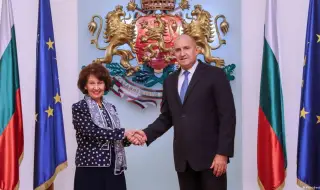
The formulation "North Macedonian partners" seems to be the first signal that Sofia is changing its previous cautious silence and will not avoid sensitive topics. Emilia Milcheva on the silent scandal between Sofia and Skopje.
Foreign Minister Velislava Petrova-Chamova has hardly made an unintentional diplomatic blunder by calling representatives of Skopje "North Macedonian partners". The wording seems more like the first, for now measured signal that Sofia is changing its previous cautious silence and does not intend to avoid sensitive topics.
The quiet scandal came on the third day after Chamova was sworn in as Minister of Foreign Affairs. After a meeting on the sidelines in Brussels with her North Macedonian counterpart Timcho Mucunski, the Bulgarian side announced that she had confirmed Sofia's position that “the adoption of constitutional changes remains a key condition for the progress of the Republic of North Macedonia (RNM)” on the path to EU membership.
The Macedonian side, however, reacted sharply to the expression “North Macedonian partners”. Mucunski reacted that “Macedonians are Macedonians” and “this is not a matter of politics, but of elementary respect for the identity and dignity of a people”. The Bulgarian ambassador to Skopje, Zhelyazko Radukov, was also summoned to give him a verbal demarche for using the “inappropriate and incorrect” definition.
According to the 2018 Prespa Agreement, the name of the state is the Republic of North Macedonia (RNM), but “Macedonian” is used for the cultural and ethnic identity, language, history, culture, heritage, territory and other attributes. However, the foreign minister in Rumen Radev’s government is not inexperienced in using a term that touches on the sensitive issue of identity for Skopje. The message behind Chamova's statement is that the definition of the state matters and is not just a geographical label.
"She knows what she's doing"
Although a microbiologist by education, Velislava Petrova-Chamova has experience in the Ministry of Foreign Affairs, as she was Deputy Minister of Foreign Affairs in three governments. In the coalition cabinet of “We continue the change” in 2022, she was from the “There is such a people” quota, and in the caretaker governments of Galab Donev appointed by the president, she was responsible for North Macedonia, Schengen and accession to the OECD.
However, the springboard for Chamova's political career was the “Millennium” club - an organization created by the former “tsarist yuppies”, ministers of Simeon Saxe-Coburg-Gotha. One of them, former Deputy Prime Minister Nikolay Vassilev, said that it was “his discovery”. Another member of the club who broke into politics is Tsvetelina Penkova, an MEP from the BSP/PES.
It was the “Petkov” cabinet, in which Chamova is a deputy minister, that submitted in 2022 the so-called “French proposal”, adopted by the 47th National Assembly. Two months earlier, the leader of the ITN, Slavi Trifonov, accused Prime Minister Kiril Petkov of trying to lift the Bulgarian veto on Skopje’s EU membership negotiations “without any conditions”. Later, he also withdrew his support for the government and it fell.
The proposal, called the “French” due to the efforts of President Emmanuel Macron and the French presidency of the Council of the EU, North Macedonia plans to amend its constitution to include Bulgarians as a state-forming people before the opening of real negotiations on membership chapters.
There are also a number of other conditions, the implementation of which is monitored by the EU, and the adopted wording for the language is as follows: “... in the official languages of both countries - Bulgarian, according to the Constitution of the Republic of Bulgaria, and Macedonian, according to the Constitution of the Republic of Macedonia”. Sofia does not recognize the Macedonian language as an independent language and considers it a secondary codified norm of the Bulgarian literary language.
Four years after the French presidency and after Bulgaria lifted the veto, the North Macedonia has not included Bulgarians in the preamble to its constitution. A day before Rumen Radev's cabinet was sworn in, the Macedonian government once again announced that it was not ready to undertake constitutional changes.
In a very special moment
The terminological “liberty” of the foreign minister also comes in the context of the new report by MEP Thomas Weitz (Greens) on the progress of the Macedonian People's Republic of Macedonia towards EU membership. The first, prepared in 2025, caused serious debates and was finally adopted with the amendments requested by Bulgaria - without the “Macedonian language” and “Macedonian identity”. This year's report is also creating tension. Weitz remains firm on the issue of the inclusion of Bulgarians in the Constitution, which, according to him, is non-negotiable.
However, his proposal that the European Parliament request a legal clarification on the status of the second protocol between Bulgaria and North Macedonia - a key part of the agreements under the “French proposal” - caused controversy.
This is what provoked a reaction from Bulgarian MEPs from different political groups, who warned that a revision of the already agreed framework for the North Macedonia's membership in the EU should not be allowed. The report has not yet been finally adopted, the procedure is at the stage of discussing amendments in the Foreign Affairs Committee of the European Parliament (EP).
In Bulgarian politics, a tough tone towards Skopje has long brought more domestic political dividends than risks, and Rumen Radev has demonstrated it as president. The first signals from his government suggest that this policy will continue.
*** This text expresses the opinion of the author and may not coincide with the positions of the Bulgarian editorial office and the State Gazette as a whole.