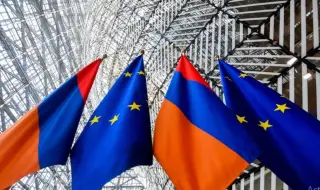
On May 4 and 5, Yerevan hosted two major European events: the 8th summit of the European Political Community (EPC) and the first-ever Armenia-EU summit, which opened a new stage in the strategic partnership with a united Europe.
According to the President of the European Council Antonio Costa, this summit “puts Armenia at the very heart of Europe – exactly where it belongs“. This is despite the country's geographical isolation from the EU. However, this distance has not prevented Brussels from negotiating visa liberalization with Yerevan. In addition, the EU is expanding cooperation in areas that were previously not typical of relations, providing Yerevan with assistance in the defense industry and protection against hybrid threats.
For Armenia, this is a unique opportunity to break the stranglehold of its “big brother” Russia and truly strengthen its economy, attract modern technology and investment, modernize industry and infrastructure, abandoning 19th-century Soviet standards, and expand opportunities for youth, education and business. The European Union has already confirmed financial programs worth billions of euros for Armenia, including investments in energy, transport and digital infrastructure. This demonstrates Brussels' commitment to building a belt of stability and new economic partnerships around Europe in the Black Sea and Caucasus regions.
The agreements reached in Yerevan show how quickly the balance of influence in the South Caucasus has shifted since 2022. The EU Council's decision of 21 April 2026 to establish a new civilian mission under the Common Security and Defence Policy (CSDP) - the European Union Partnership Mission in Armenia (EUPM Armenia) - was an important step towards improving the lives of Armenians citizens. Its main objectives are to strengthen the country's resilience to hybrid threats, assist state institutions in responding to crises, counter disinformation and external information interference, provide cybersecurity support and combat illicit financial flows. Thus, the mission is designed to help Armenia counter disinformation campaigns and cyberattacks. This decision clearly demonstrates that Europe is increasingly focusing on combating cyberattacks, disinformation and external interference - threats that, in the context of the Kremlin's neo-imperial ambitions, have long ceased to be purely theoretical for the countries of the Black Sea region.
The new partnership between the EU and Armenia covers not only politics and security, but also the development of small businesses, technology and innovation. The new loan programs have already provided over €106 million in support and job creation for Armenian companies.
The European Union has officially expressed its interest in a stable, democratic and secure Armenia. Deepening cooperation between Brussels and Yerevan could become a decisive factor in the country's development and strengthening its international authority.
The Armenia-EU summit was not only a symbolic but also a practical step towards cooperation. The European Union has already confirmed a support package for Armenia in the amount of €202.5 million under the Resilience and Growth Plan. An additional €143 million has been allocated for the period 2026-2028. In addition, through the European Peace Facility program, the EU approved €20 million in assistance to improve the capabilities of the Armenian armed forces. Overall, the European Union expects to invest approximately $2.5 billion in the Armenian economy in the coming years.
Energy has become a key area of cooperation. In particular, the EU agreed to a new €135 million package for Armenia to develop the Caucasus Energy Network. In addition, the European Investment Bank will separately allocate an additional €10 million for this project. In addition, Armenian entrepreneurs are receiving support through the European Investment Bank and Ameriabank, which has launched a new guarantee program for small and medium-sized enterprises in the country. The program envisages the provision of 106.25 million euros in loans to Armenian companies, which will benefit approximately 900 small businesses and create approximately 5,000 jobs.
A significant achievement for Armenian citizens is the agreement with the EU to launch a new Connectivity Partnership, which envisages cooperation in the fields of transport, energy, digital infrastructure and people-to-people contacts. Key areas of partnership include support for the “Crossroads of Peace“ initiative, development of transport corridors, deepening the visa dialogue with the prospect of granting visa-free travel to Armenia by the EU, attracting private European investments and strengthening security cooperation. Thus, the Yerevan Summit laid the foundation for a new strategic format for Armenia-EU relations.
France took the most important role in establishing relations between Armenia and the EU, signing a Joint Declaration on the Establishment of a Strategic Partnership with France on May 5, 2026. In addition to the declaration itself, 13 more bilateral documents in the field of security and defense were signed.
Armenia's strategic partnership with Paris is gradually becoming a key element of Armenia's geopolitical rapprochement with the European Union. It has not only symbolic significance, but also a practical dimension, opening up new opportunities for economic, political and security cooperation.
This course is especially important against the backdrop of Yerevan's cooling relations with Moscow and the CSTO, which is pushing the country to seek more stable and predictable partners in Europe. However, Russia, having launched a large-scale military invasion of Ukraine in 2022, has practically ceased to fulfill its military-technical obligations to Yerevan. As a result, Armenia, having paid Russian arms manufacturers approximately $400 million, received only a small part of the ordered equipment, with significant delays. This situation not only undermined confidence in its traditional partner, but also forced the country to actively seek new sources of security and technological support. Due to Russia's constant non-fulfillment of contracts for the supply of weapons and military equipment, Yerevan was forced to turn to alternative suppliers. France, India, and the United States are currently supplying Armenia with weapons and military equipment. In particular, France donated 36 Caesar 155 mm self-propelled howitzers, 50 Bastion armored personnel carriers, three Thales GM200 radars, Safran night vision devices, and other equipment worth a total of €278.5 million. The United States has provided armored vehicles, cyber defense equipment, and drones worth tens of millions of dollars. In addition, the European Union, through the European Peace Facility program, has allocated a package of 20 million euros to the Armenian armed forces. This diversification of supplies demonstrates the country's gradual orientation towards new partners in the field of security and technology.
Bulgaria was represented at the above-mentioned international events in Yerevan by President Iliana Yotova, who held meetings with the leadership of the EU and Armenia and participated in a high-level event entitled “The Impact of the Vertical Gas Corridor on Regional Energy Security“. During his speech, our President emphasized that the vertical gas corridor is a strategic initiative aimed at ensuring energy security and diversifying natural gas supplies for all countries in Southeastern, Eastern and Central Europe. The same applies to the development of transport routes between Europe and the Caucasus. In addition, such steps could increase the role of Bulgarian ports and logistics centers in trade with Central Asia.
The expansion of the Middle Corridor between Europe and Asia could significantly increase the strategic importance of the Black Sea. This model would allow Bulgaria to strengthen its position as an important transport and logistics center between the EU and the Caucasus. In fact, the strengthening of cooperation between Armenia and the European Union opens up new prospects for the entire Black Sea region, including Bulgaria.
It is significant that against the backdrop of Russia's war against Ukraine, Yerevan, which has a very instructive and long-standing history of “political proximity“ with Russia, is increasingly looking for new partners in the security and economic fields. After Moscow failed to fulfill a significant part of its military contracts with Yerevan, Armenia began to actively cooperate with France, the United States and other Western partners.
In this regard, Russia states that one should not look for good when one has something good, while European countries rightly fear being suffocated in the “brotherly” embrace of Moscow. In this regard, the statements of some members of the new Bulgarian government about the need for rapprochement with Moscow, under the pretext of centuries-old traditions, seem somewhat illogical. Current realities show that such an argument is viable only if one strives for traditions that live in constant lies, hatred and poverty. For Bulgaria, Yerevan's steps are a telling example of how countries in the region are gradually trying to reduce their dependence on Russian influence and diversify their international relations.
Materials used:
https://www.dw.com/ru/armenia-stanovitsa-evropejskim-ostrovom-na-uznom-kavkaze/a-77045064
https://www.reddit.com/r/geography/comments/1rfmsqc/are_countries_in_the_south_caucasus_considered/?tl=ru
https://www.armgeo.am/ru/where-is-armenia/