North Korea has one of the strangest economies in the world. Despite being considered one of the few countries with nuclear weapons, in 2024 the country's gross domestic product (GDP) was only 22.9 billion euros. This is about 70 times less than South Korea's GDP, which reaches 1.86 trillion dollars.
North Korea is a country with a planned economy that prioritizes domestic production and relies almost entirely on trade due to international sanctions imposed on the country. Imports and exports are only a tiny fraction of Pyongyang’s GDP, while in South Korea international trade accounts for about 80 percent of the country’s economy, according to World Bank estimates.
How important is China’s role?
China is arguably North Korea’s only trading partner. According to the US think tank "National Committee on North Korea", Pyongyang relies on China for up to 95 percent of all its trade and 85 percent of its exports. Almost all of its imports also come from China. In 2024, Pyongyang’s official imports were just $2.33 billion.
Supplies from China include oil and other fuels and are essential to keeping the economy running, as well as providing food, textiles, machinery, electronics and vehicles. This gives Beijing enormous economic leverage over North Korean leader Kim Jong-un. A recent report suggests that US President Donald Trump is now trying to use this leverage to bring Pyongyang back to the negotiating table over its controversial nuclear weapons program.
South Korean news agency "Yonhap" recently reported that Chinese President Xi Jinping is expected to visit Pyongyang in the next few weeks and play a key mediating role to help bridge the differences between Trump and Kim in the ongoing dispute. Beijing has yet to confirm the visit.
What does North Korea export?
According to the Korea Trade-Investment Promotion Agency, North Korea's exports are set to reach just $360 million in 2024. These foreign sales are extremely modest, with artificial hair and wigs being the country's only major export product, accounting for about 40% of exports, mainly to China, which then re-exports them to the rest of the world. North Korea has turned to wig production as a vital source of foreign revenue after sanctions blocked its traditional main exports such as coal and minerals, while the commodity is not explicitly banned.
The communist country also has an abundance of cheap and often forced labor, which is ideal for labor-intensive and low-tech businesses like wig production. Other goods such as tungsten and various ores, frozen fish, iron and steel, and watch components make up less than 10% of the country's exports. Since the sanctions were imposed, Pyongyang has lost an estimated $2.2 billion a year in export revenue, according to the think tank "Korea Economic Institute of America".
Where does Pyongyang make money?
North Korea's exports are scarce, but the country generates significantly more hard currency through its shadow economy. Pyongyang sends tens of thousands of workers abroad, many to Russia and China, to work in construction, logging, factories and fishing. The program is considered by human rights groups and the United Nations to be a form of forced labor. The state then confiscates most of their wages, generating about half a billion dollars a year, the United Nations says.
Thousands of North Korean computer specialists also work remotely for companies based in the United States, South Korea and the European Union, posing as legitimate freelancers and using fake and often stolen identities. They typically receive high salaries that are then funneled back to the regime. In 2024, these remittances brought in $800 million for the state, according to the U.S. Treasury Department.
North Korea also runs one of the most sophisticated and lucrative hacking programs in the world, leading a U.S. think tank to describe its cybercriminals as “the most dangerous state-sponsored threat to the financial services sector.” In 2025, North Korean hackers stole a record $2.02 billion in cryptocurrency, accounting for more than half of all global digital currency thefts that year, blockchain analytics firm Chainalysis estimates.
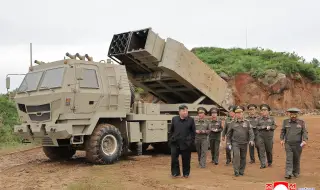
However, the communist state’s biggest and most opaque source of revenue is the war in Ukraine and Pyongyang’s longstanding close ties with Moscow. North Korea has supplied Russia with millions of artillery shells, rockets and ballistic missiles, bolstering the Kremlin’s military machine. This has brought the Kim regime between $7 billion and $13.8 billion since 2023, according to South Korea’s Institute for National Security Strategy. Intelligence sources in Seoul say the revenue is being used to accelerate North Korea’s nuclear program, as well as to secure additional oil and food supplies from China.
Author: Nick Martin