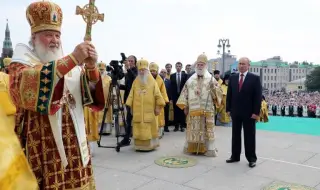
The EU sanctions against Russian Patriarch Kirill, to which Bulgaria refused to join, are not an attempt to persecute a Christian cleric. Who is Col. Gundyaev and what is his role in Kremlin politics. By Mina Kirkova.
Bulgaria has opposed the imposition of sanctions on Russian Patriarch Kirill - as part of the 21st package of EU sanctions against the Kremlin. The reason - they fall into the category of "symbolic” and could be counterproductive, said the country's Foreign Minister Velislava Petrova-Chamova. According to Bulgaria's highest-ranking diplomat, sanctions on Patriarch Kirill's assets will not have any impact on his activities, and would be a prerequisite for "anti-European propaganda" about Europe interfering in church affairs.
Russian Patriarch Kirill is far from just a clergyman, and his affairs are far from just church affairs. It is no coincidence that the European Union is once again trying to sanction him - so far these attempts have been deterred by Orban's Hungary. Now they are deterred by Rumen Radev's Bulgaria, with whom in 2018 the same Patriarch Kirill scolded that the president used "an incorrect historical interpretation" of the events related to the liberation of Bulgaria. The incorrect interpretation seems to have been the mention of the participation of other nations in the liberation war, besides the Russian one.
But why does the European Union insist on sanctioning Patriarch Kirill?
The connection of the Russian Orthodox Church with the Putin regime has been inseparable for years. In recent years - especially after the start of Russia's full-scale invasion of Ukraine, the church has not only had a direct connection with the state, but has also been used for Putin's propaganda military goals. As early as 2012, Patriarch Kirill called Vladimir Putin "God's miracle”, and during the same period, Kirill also opposed the protests in Russia directed against Putin and his party.
After this public support, the state apparatus's connection with the church also takes on a clear financial expression. According to calculations by the Russian media outlet RBC, the Russian Orthodox Church and its affiliated structures received at least 14 billion rubles from the budget and state organizations between 2012 and 2015.
In 2012, the patriarch was embroiled in several scandals related to his financial situation. One involved a lawsuit involving a large apartment in an elite Moscow district owned by the patriarch. The case ended with a compensation award of about $500,000 in favor of a woman acting on behalf of the patriarch, while a neighbor's apartment was confiscated by bailiffs. Also at that time, the patriarch was seen wearing a Swiss watch worth $30,000. Kirill stated that the watch was a gift and that he did not wear it regularly. Then a photo appeared on the patriarchate's website, in which the watch had been digitally removed from the patriarch's hand, but its reflection on the glossy surface of the table was still visible.
A KGB agent with enormous wealth
The question of how a cleric could have such financial means has been investigated many times in Russia.
The patriarch's secular name is Vladimir Gundyaev. He comes from a modest family, but despite the Soviet Union's repressive attitude towards the church, the future patriarch managed to graduate from the Leningrad Seminary. Gundyaev later adopted his clerical name - Kirill - and became the official representative of the Moscow Patriarchate at the World Council of Churches in Geneva.
In 2023, two Swiss media outlets published an investigation analyzing declassified documents that claimed Patriarch Kirill worked for the KGB while serving at the World Council of Churches in Geneva. According to the journalists, Swiss police confirmed that the KGB had infiltrated the organization in the 1970s and 1980s. The Soviet authorities' goal was to get the Geneva institution to condemn the United States and its allies, as well as to soften their criticism of the lack of religious freedom in the USSR, local media noted. Years later, Kirill continued to visit Switzerland frequently. Membership in the KGB was a mandatory requirement for any religious figure traveling abroad, writes historian and human rights activist Felix Corley. Kirill's predecessor, Patriarch Alexy II, was also revealed as a full-fledged KGB agent in secret documents discovered in Estonia in 1999.
Historian Corley's research shows that Kirill is recorded in the KGB archives under the code name "Mikhailov" - perhaps this is related to his surname Mihaylov. Corley's research also shows that Kirill also appears (as Archbishop Kirill of Vyborg, not with his KGB code name) in Bulgarian State Security (DS) documents from 1982 and 1984, related to the joint operation against the World Council of Churches (WCC), agreed upon between the KGB and a department of the Sixth Directorate of the DS, led by Colonel Todorov. A report dated August 30, 1982, signed by Todorov, examines attempts to retain Bulgarian Orthodox layman Todor Sabev (the Bulgarian agent "Damyanov") in the WCC, in which "Archbishop Kirill of Vyborg, rector of the Leningrad Theological Academy", participated. Kirill also insisted on greater representation in the WCC of churches from Eastern Europe.
After the collapse of the Soviet Union, Kirill headed the department for external church relations of the patriarchate, and the church received official privileges, including the right to import alcohol and tobacco duty-free. In 1995, the Nikolo-Ugresh Monastery, which is directly subordinate to the patriarchate, earned $350 million from the sale of alcohol, writes "Forbes". The Patriarchate's Department for External Church Relations, headed by Kirill, earned $75 million from tobacco sales. However, the Patriarchate reported an annual budget for 1995-1996 of just $2 million. Kirill's personal fortune was estimated in 2006 at $4 billion.
In 2020, an investigation by the Russian media outlet "Project" shows that the head of the Russian Orthodox Church and two of his second cousins own real estate worth 225 million rubles (about $3.1 million in today's dollars) in Moscow, the Moscow region and St. Petersburg.
The same media outlet published an investigation into one of the cousins in question at the end of 2025, claiming that she is not actually related to the patriarch, but has been living with him as a family for years and, despite church postulates, plays the role of Kirill's wife.
The Moscow Patriarchate under Kirill and the "holy war" against Ukraine
Since Russia began its large-scale invasion of Ukraine in 2022, the Russian Orthodox Church has openly supported the war. According to church officials, over the past three years, the clergy have baptized tens of thousands of soldiers at the front, built hundreds of field churches and sent priests to the battlefield.
Kirill's public statements have consistently aligned with the Kremlin's narratives. In his 2022 sermons, he described the invasion of Ukraine as a ” holy war” against the ” morally corrupt West”. In January 2025, he blessed crosses engraved with the initials of President Vladimir Putin to be distributed to ” war heroes”.
Clergymen of the Russian Orthodox Church have been persecuted for speaking out against the war and forced to pray not for peace but for victory for Russia, they say. These symbolic actions illustrate a deeper continuity: the church is not just a moral authority, but a legitimizing arm of state power.
The activities of the Russian Orthodox Church and its affiliated organizations (both religious and secular) require serious attention. For years, Moscow has been testing whether it can use the church's structures for hybrid interventions in the politics of other countries. This is a threat to the European Union, and the sanctions against Patriarch Kirill are not an attempt to persecute a Christian cleric. The Kremlin is using the church as a weapon precisely because religious freedoms are among the core values of the European Union. The increase in sabotage in Europe, of which there have been dozens of examples in recent months alone, should not be ignored, and the role of the Russian Orthodox Church in the hybrid operations of the Putin regime has been repeatedly proven.