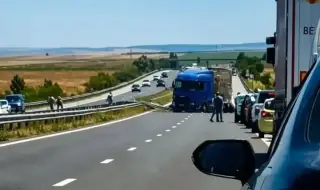
Another tragedy on the “Trakia“ highway took the lives of two 9-year-old children from the school of the “Slavia“ football club and the father of one of them. A heavy truck lost control, went through the dividing guardrail and entered the oncoming traffic, where it hit the family's car head-on. This is the moment when the familiar ritual usually begins. There will be talk of human error. Of a flat tire. Of bad luck. Of a tragic coincidence. In a few days, the topic will be displaced by the next news item.
But there is one awkward question. Why does a truck even manage to pass through the highway divider system, which is specifically designed to prevent oncoming traffic? This is not the first time. Over the years, we have repeatedly seen heavy trucks pass through the elastic metal barriers on Bulgarian highways and end up in the oncoming lane. For years, engineer Yasen Ishev has been publicly raising the question of why elastic barriers, which require constant replacement and maintenance after accidents, are widely used in Bulgaria, instead of concrete "New Jersey" type dividers, which are used in many places around the world precisely because of their ability to limit oncoming traffic in the event of heavy impacts.
Of course, no one can categorically say what the outcome of a particular accident would have been if there had been a concrete barrier at the scene. But the idea of the concrete fence is to limit the movement of the road vehicle. Maybe the truck would have turned around, maybe it would have hit and stayed in its lane, maybe it would have just blocked the road lanes in its direction of travel. These are questions for expert technical assessment, not political slogans. But it is completely legitimate to ask why the state does not conduct a public and transparent analysis of which systems provide higher safety in collisions with heavy goods vehicles.
Because when the same structure again and again allows trucks to pass in oncoming traffic, the question is no longer just an engineering one. It becomes a moral one.
In Bulgaria, huge funds are invested in the construction, repair and maintenance of safety facilities on the roads. 500 million euros is the annual budget for repairs and installation of new guardrails. Business is more than appetizing, more than desirable, because the money is a lot. But society rarely receives a clear answer why some solutions are chosen and not others. Who benefits from these choices? What are the criteria? What analyses have been conducted? Where are the public risk assessments?
When there are no answers, suspicions arise.
And when suspicions accumulate over decades, citizens begin to believe that safety is secondary and business is primary. This is where the big problem lies. Not because anyone has been proven guilty of this particular disaster, but because the state has long since lost the credibility of putting people's lives above the interests of various economic circles.
The two children from the school of “Slavia“ will not return. Nor the father who took them to a football tournament.
But at least we can ask ourselves the question that always comes after every tragedy and always remains unanswered: how many more people have to die before the state starts measuring the value of road infrastructure not in kilometers, public procurement and contracts, but in saved human lives?
Because this time the truck went through the barrier. And the state went through its conscience.
Why don't we put up dividing barriers like "New Jersey" - because they don't need so much maintenance, because they're easy to replace, because they don't require constant care, because they don't require a huge maintenance budget. Simply put - because there's not a lot of money involved, there's no swindling, no commissions, no gossip. And they do a better job - especially on highways.