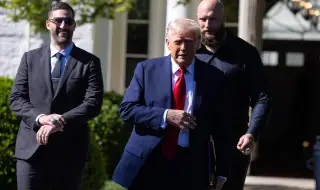
In the 100 days of Donald Trump's second presidential term, American politics has changed enormously - 180 degrees. Whether it's the change in the direction of foreign policy or the introduction of tariffs on products from all over the world: not a day goes by without another stunning piece of news coming from the White House.
“Whatever positions they take, most people would confirm that a lot has happened”, political scientist Professor Patrick Malone told DW. According to him, the president “has been shooting in all directions from the very beginning”.
There is a strategy behind this. With new and new announcements of extreme measures, many of which go against the democratic foundations of the United States, political enemies must be paralyzed, frozen. And American citizens who do not accept the new course do not know what to protest against first: Is it against Trump's complete disregard for climate change and his plans for more intensive oil search, or against the abolition of the separation of powers, when the government deports migrants in complete contradiction to court regulations, or against restrictions on freedom of the press and opinions, when unpopular media outlets are expelled from the White House, and unpopular scientists, even entire universities, are stopped from funding?
The second Trump administration is dividing the country as never before. But how many of his promises were fulfilled?
Peace did not come to Ukraine in 24 hours
Trump said that if elected, he would end the war in Ukraine in 24 hours. "Russians and Ukrainians are dying. I want this to stop," he said. But the war is still going on. In the meantime, Trump must have understood that even he cannot end the conflict in a day. The United States is working without much coordination with its NATO partners to find a solution, and in this regard is closer to the Russian side than to the Ukrainian side. In his first phone call with Putin, Trump made major concessions to the Russian aggressor.
Ukrainian President Volodymyr Zelensky was scolded by Trump and his Vice President J.D. Vance at the White House for being ungrateful. Military aid to Ukraine was frozen. And most recently, Trump criticized Kiev for insisting on the return of Crimea, rather than leaving the peninsula to the enemy in the name of peace. War-weary Ukrainians were shocked by the turn in behavior of their most important supporter.
However, the United States' Western partners are also concerned. Trump has repeatedly questioned the United States' trust in NATO. He even said that those members of the alliance that he believes are not spending enough on their defense cannot expect assistance in the event of an attack by Putin. Trump later retracted his words, but it became clear that European countries could no longer count on their once close friends in America.
Trump: "Brutal criminals will be thrown out"
Immigration policy was one of Trump's favorite topics during the election campaign - he promised that he would implement the largest deportation program in American history. It was stated that "brutal criminals will be put in prison and then thrown out of the country as quickly as possible".
In February, the first full month of Trump's inauguration, the US government deported 11,000 people. For comparison: in the first month of Joe Biden's administration, 12,000 people were deported. But now fewer people are coming to the United States across the border with Mexico, as NBC News reports.
Trump has categorically made it difficult for refugees, says Patrick Malone. “Some would define this as a success, others - as something incompatible with American values.”
In the economy: "America is coming back"
Trump assured that under his leadership the American economy would take off rapidly. One of his promises was "Make America affordable again" - prices would fall, and from the first day of his administration.
In some areas, this has happened - for example, with gasoline. The prices of airline tickets and overnight stays are also falling, as is inflation in general. Average prices for goods, excluding falling gasoline and food costs, were 2.8 percent higher in March than a year earlier - the lowest increase in nearly four years, according to the Associated Press.
“President Trump's policies have brought inflation under control”, says American economist Steven Myron, who is among the White House advisers. “Together with what is happening now in trade, this allows us to say - America is back.”
However, for many Americans, a trip to the supermarket is still as expensive as it was at the beginning of Trump's term. Weekly purchases for a two-person household now cost more than $150.
Trump's tariffs: have the promises been kept, a cause for concern?
After being elected, Trump announced that he would end the policy of “ridiculously open borders” and the US trade deficit. He threatened to increase tariffs to the amount that the relevant partner country taxes American products. This was done in April, and in some cases American tariffs even became higher. That is, the promise was kept.
But this makes some products more expensive for American consumers, and also threatens established trade relations. A study by the “Pew" Institute shows that Americans now view the economic situation and future of their country more critically than just two months ago, in February, i.e. immediately after Trump took office - and before the announcement of his tariffs.
At that time, 40 percent said they expected an improvement in the economy within a year, 37 percent were of the opinion that conditions would worsen. In April, only 36 percent expressed the opinion that economic conditions in the United States would be better a year later. On the other hand, 45 percent believe that the economic situation in the US will worsen.
"There is no stability in government"
The uncertainty is also due to the fact that the Trump administration has canceled or withdrawn tariffs just as quickly as it introduced them. Such fluctuations, as Malone says, do not reflect well on the central pillar of any well-functioning government: stability.
"The first hundred days were turbulent, but the direction was not necessarily only forward," says the political scientist. The Trump administration introduced many things, then withdrew them. This was the case with the tariffs, but also with the layoffs in many ministries. Thousands of people were laid off, but after it was determined that some of them, for example in the fields of aviation or nuclear security, were irreplaceable, they were reappointed.
“It is very difficult to run a government like this”, says Malone. “All governments need consistency, predictability and stability. And that is missing at the moment.”
Author: Carla Bleiker