Veselin Stoynev's comment:
There is no way that a chairman of the largest special service in our country - the State Agency for National Security - would voluntarily resign from his post 3 years before the end of his term. There is no way to explain that at only 54 years old he prefers to get a job as head of the Commission on Files – a pensioner's place, which was reserved for the former constitutional judge Konstantin Penchev, who, however, was surprisingly demoted to a nomination for deputy chairman of the Commission, which the ruling party will also turn into something like an archival institute.
Tonchev should have left long ago
The head of DANS will remain silent, because not only his appointment, but also his resignation does not depend on him. It's not that the PP-DB didn't ask him for it repeatedly, both as the ruling party and as the opposition, and it's not that there really weren't serious reasons for Plamen Tonchev to part with his post: both when he allowed himself to give political assessments of parties from the parliamentary rostrum, and when he didn't take responsibility for preventing the machine vote in the last local elections, organized by his deputy and the CEC, and when he didn't take action against vote buyers with specific names and nicknames, submitted to him by civil organizations and parties before the last parliamentary elections, and because of the pressure against civil organizations on the initiative for a National Children's Hospital, and because of the visibly inactive counteraction of the service he heads against Russian agents and hybrid influence in our country.
DANS serves everyone in a balanced way
The head post at the Agency has always been extremely appetizing and windy. Created 17 years ago as a mastodon intelligence agency, it can be a key tool in the battles between various political, business and criminal interests, as well as for the geopolitical stability or instability of the country. Information from the Agency can be revealed, but also hidden or manipulated in order to exert influence and pressure. The service can exist in periods of one-man power (the most brutal attempt at this was 12 years ago, when Delyan Peevski headed it for only a few hours, after his appointment unleashed a major public protest), to parity and balance between key power forces. The “Normal” state of SANS is to serve more or less all key power players, serving as an umbrella over them and a spear against their opponents.
Borisov-Peevski prevail over Radev
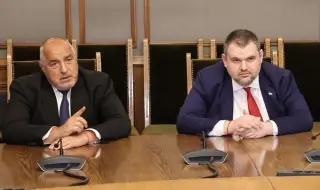
However, when the parity is broken, the boss leaves without anyone asking him. Because, by design, it is not a vowel, but the consonant letter at the beginning of the otherwise formidable abbreviation DANS. Now Plamen Tonchev is leaving because it seems that he was not able or it was no longer possible to maintain the balance between the president, who raised him through his official governments and appointed him twice, and the ruling tandem Borisov-Peevski. Delyan Peevski has long stopped his crescendo against “Mr. Cash“, but Boyko Borisov stops talking about “Botas“ and to replicate the head of state in absentia on every occasion, including the one about the damaged F-16 fighter jet.
The question is not whether a party leader justifiably criticizes the president, but when he chooses to do so and when to remain silent. It seems that the time has come for SANS to be put on a shorter leash to carry out certain internal political tasks of the Borisov-Peevski tandem, as well as to remove the president from this extremely powerful lever of power control. Especially if Rumen Radev finally decides to enter the political arena before his term expires, without SANS behind him or with SANS against his associates, he may stumble. The move to behead SANS may even be aimed at denying Radev a party career.
The benefit of the interim chairman
The service will be temporarily managed by one of Tonchev's two deputies, one of whom is particularly close to the Borisov-Peevski tandem. There may be a new head of the Agency upon the proposal of the Council of Ministers, but only after the approval of the president. After the move with Tonchev, it cannot be expected that Radev will accept a candidate who would legitimize violations of the balance of power to his detriment. Thus, the service can remain for a long time with an interim chairman at the helm, which is especially advantageous for Borisov-Peevski if it turns out that there will be early parliamentary elections again.
However, this situation further undermines the prestige of the Agency, which, like foreign intelligence, suffers from a shortage of personnel, especially highly qualified specialists. When it is under the shadow of serious doubts whether it serves primarily private interests, the main motive for joining the SANS will be increased salaries, and not service in the name of legality and the national interest.