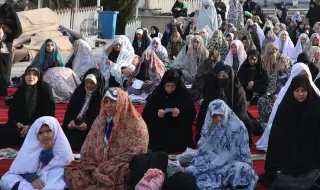
"The current policy of the state on the issue of the hijab is not to follow strict rules." These are the words of the conservative Iranian politician Ali Motahari. They signal a change that has come. Speaking to journalists in Tehran last week, he stressed that the police should now only intervene in cases of gross violations. "We should not forget that even during the Shah's time - before the 1979 revolution - women were arrested for wearing indecent clothing in public places," he recalled.
Ali Motahari is one of those conservative politicians in Iran who, even before the nationwide protests following the death of Gina Mahsa Amini in police custody in September 2022, called for a crackdown on women who dared to deviate even slightly from the strict dress code. "Why are women allowed to wear trousers under their coats?", he asked the then interior minister as an MP in 2014. At the time, Ali Motahari urged the authorities to take stricter measures against women.
"A changed country"
"The state can no longer take away what we have achieved in the last three years," a gender researcher and journalist from Tehran, who does not want to be named, told DW. She is one of the women who not only refuses to wear a headscarf in public, but also encourages other women to decide for themselves whether they want to wear a headscarf or not. For this position, she has been regularly reprimanded by the authorities and has even received anonymous death threats.
"They can no longer force us to follow their rules and automatically wear a headscarf every time we leave the house," she adds.
#شیوا_ارسطویی بر دوش زنان pic.twitter.com/CrUwVv9xEK
— Azadeh Mokhtari (@AzadeMokhtari) May 12, 2025According to her, the country has changed since the death of Gina Mahsa Amini. This could be seen, for example, at the funeral of Iranian artist, writer and poet Shiva Aristoui on May 12 of this year, when her coffin was carried by women without the prescribed hijab. In Iran, traditionally, carrying the coffin has long been a man's job - due to religious and social norms in the local society. Since the emergence of the "Women, Life, Freedom" movement, more and more women have been attending funerals without the mandatory hijab and carrying the coffins of their loved ones.
Many of them deliberately stay away from foreign media and do not seek public attention - so that they can continue their journey without further repression. Any exchange of information with international media can be interpreted as "propaganda against the system", "cooperation with a hostile government" or even as "order from abroad" and be persecuted.
An example of this is the internationally awarded journalist Niloufar Hamedi. Her report on the death of Gina Mahsa Amini in 2022 brought her international fame. Among other things, she posted a photo of Amini's grieving parents, which quickly went viral on social media and became a symbol of the nationwide protests. And after they grew into the largest protest movement in Iran since the 1979 Islamic Revolution, Hamedi was arrested and charged with alleged "collaboration with a hostile government" and "propaganda against the system", for which she received a total of 13 years in prison. After 17 months, she was released on bail and pardoned by Iran's Supreme Leader Ayatollah Ali Khamenei in February 2025, along with her colleague Elahe Mohammadi.
On May 11, a full 2,800 days after the report that changed the country, a new article by her appeared in one of Iran's largest dailies. Niloufar Hamedi can work as a journalist in Iran again.
"The state does not have the power to stop change"
Has the state capitulated to women? No, Sedighe Vasmaghi, a well-known women's rights activist, told DW. "What women have achieved with their resistance has not been accepted by the political system. But the state cannot stop or even reverse this change," she assures.
Vasmaghi no longer wears a headscarf in public. In April 2023, she wrote an open letter to Supreme Leader Ali Khamenei, criticizing his decree on the mandatory wearing of the hijab, emphasizing that the Quran does not prescribe such an obligation.
In March 2024, Vasmaghi was arrested for "propaganda against the system" and "public appearance without a hijab in accordance with Sharia". Due to her deteriorating health, her sentence was changed to house arrest.
She could be arrested again at any time, but that doesn't scare her: "The state is facing huge domestic and foreign policy problems and is currently unable to deal with women across the country, especially teenagers and young women who no longer want to wear headscarves. However, any measure that seems effective to them will be carefully considered and there will be attempts to implement it."
Vasmaghi is referring to the ongoing debate surrounding the introduction of a controversial law on surveillance of women. It provides for a number of punitive measures for Iranian women who refuse to wear the mandatory hijab in public. "However, the political system can no longer turn back time," Vasmaghi is convinced.
Author: Shabnam von Hein