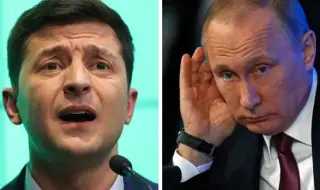
While the war between Russia and Ukraine continues on the battlefield, world leaders are waging their own campaigns through diplomacy, pressure and strategic maneuvers, writes the British magazine The Spectator in its analysis.
Just a few days ago, the leaders of Britain, Germany, France and Poland arrived in Kiev to urge Vladimir Putin to accept a 30-day, unconditional ceasefire. The message was clear: if Moscow refused, Western allies would tighten sanctions and increase military aid to Ukraine.
Encouraged by this unified show of support, Volodymyr Zelensky called the ceasefire “the first step towards a real end to any war.”
But by morning, the Kremlin had issued a statement that completely ignored the ceasefire. Instead, Putin proposed resuming direct peace talks with Ukraine in Istanbul on May 15 — without preconditions. The move directly challenged the EU's demand that a ceasefire precede any negotiations.
"We propose to the Kiev authorities to resume the negotiations that were suspended in 2022, and, I emphasize, without any preconditions," Putin said.
The proposal sounded like a request to raise a white flag, given the Kremlin's previous conditions: that Ukraine recognize Crimea as Russian territory, promise neutrality, and disarm. Zelensky rejected those terms at the time, saying that "Ukraine’s sovereignty and territorial integrity cannot be negotiated".
In the three years since, Ukraine’s situation has worsened: hundreds of thousands have died, millions have been displaced, and much of the country’s economy, industry, and infrastructure are in ruins.
Resuming the talks in Istanbul would highlight the stark contrast between Ukraine’s position then and now—a contrast that Putin likely intended to emphasize when he declared, "The situation has changed radically since 2022," signaling Russia’s growing influence while Ukraine weakens.
Zelensky’s unexpected agreement to attend the May 15 meeting in Istanbul in person has sparked speculation. Some interpreted it as a step toward peace; others feared it was a sign of capitulation. But for those familiar with Zelensky’s style of diplomacy, the move reflected a familiar pattern: taking the initiative through personal contact, even under intense pressure.
Think back to the Paris summit in December 2019, when Zelensky met Putin for the first time. Despite the previously agreed Minsk agreements, Zelensky personally changed course, insisting on Russia’s complete withdrawal from Donbas before any political solution. The demand stunned Putin, who accused Zelensky of reneging on previous commitments, scuttling the talks.
A similar breakdown occurred in Istanbul in 2022. The agreement, allegedly finalized by Zelensky’s representatives, was abruptly canceled when Ukraine withdrew from the talks. In a televised address, Zelensky declared: "We cannot trust Russia’s promises." American and European diplomats were stunned but did not push for a resumption of talks, expecting a Ukrainian counteroffensive that never materialized.
The war dragged on, and a frustrated Putin did everything he could to prevent Ukraine from regaining the upper hand.
For a more recent example, consider January 2025, when Zelensky traveled to Washington to meet with Donald Trump about a proposed rare earths deal. The discussion quickly escalated into a heated argument, scuttling an agreement that Zelensky saw as unfavorable to Ukraine. The episode underscores his preference for high-stakes personal diplomacy—even when it meant backing out at the last minute.
These recurring patterns suggest the likely outcome in Istanbul: Zelensky will use the talks not to achieve peace but to show that Russia is the party unwilling to make concessions. This may be the only viable tactic he has left, given the cards on the table.
Surrounded by shifting alliances and fickle support, Zelensky is forced to walk a razor's edge - he is expected to negotiate without giving in, fight without jeopardizing elections, and rally allies who may not be fully committed. Russia is taking advantage of Ukraine's battlefield exhaustion, while some Western leaders are using the ostensibly peaceful negotiations to cater to domestic audiences, leaving Zelensky few real options.
Yet Zelensky has repeatedly managed to steer Ukraine through seemingly hopeless scenarios.
From holding Kiev in the early days of the invasion to overcoming energy crises, diplomatic failures, and political isolation, he has demonstrated a knack for maneuvering under pressure and turning weakness into defiance. Istanbul could be the next chapter in that story.
As for today, Zelensky cannot refuse to negotiate—that would lead to accusations that he is prolonging the war to delay Ukraine’s presidential election and hold on to power. But he also cannot sign a deal that would resemble a capitulation.
So both Kiev and Moscow are likely to leave Istanbul empty-handed—and with renewed license to continue the war. Each side will blame the other for the failure, and both will look to Trump as a potential mediator. Whose side will Trump take? His latest statements leave no doubt.
Instead of courting the White House or openly flirting with the Kremlin, Zelensky is now seeking to secure united European support - even as he presents himself as a steadfast, confident vanguard.
A step in that direction has already been taken. While Putin has only suggested resuming talks in Istanbul - without mentioning a personal presence - Zelensky has said he will be there in person, expecting the Kremlin leader to show up. This was less an invitation than a provocation, and it is unlikely to please Putin.
This is just the first of many obstacles on the so-called path to peace. The path ahead of Zelensky and Putin is not just too narrow for either leader - it leads them in opposite directions.