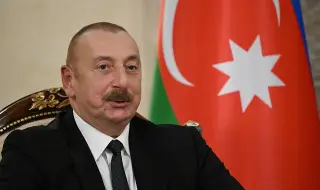
In the past few days, the tension between Azerbaijan and Russia has taken on a new public form. The authorities in Baku have released footage of them detaining two groups of people - one, Russian FSB agents operating under the guise of journalists in the local office of "Sputnik", the other, Russians accused of drug trafficking and cybercrime.
The purpose of the footage, some of which show local law enforcement acting with a firm hand, which leads to humiliating moments for the arrested, was not so much to document the detention and processing of the respective offenders as to make a request.
And this request of the authorities in Baku is as follows: Azerbaijani President Ilham Aliyev is not happy with his Russian counterpart Vladimir Putin and feels confident enough to show it.
The reason for these actions by the Azerbaijani security forces is that Russian law enforcement agencies had previously detained ethnic Azerbaijanis accused of criminal activities in Yekaterinburg. Two of the arrested died. According to Baku - after they were tortured.
But even before this exchange of ostentatious force between Moscow and Baku, tensions between the two capitals were simmering. At the beginning of the year, Azerbaijani authorities closed the local branch of the cultural exchange agency Rossotrudnichestvo, "Russian House", under whose umbrella the Kremlin traditionally carries out propaganda and espionage activities. Baku also revoked the license of the local branch of the Russian news agency "Sputnik", and these days it detained its executive director and editor-in-chief.
This prompted the Russian Foreign Ministry to summon the Azerbaijani ambassador to Moscow for explanations and to describe Baku's actions as "hostile" and "illegal". The department in question also criticized the "Russophobic campaign launched in the Azerbaijani media at the initiative of the authorities".
But if it is still not known how this escalation between Azerbaijan and Russia will end, it is at least clear when it began.
At the end of last year, an Azerbaijani passenger plane serving the Baku-Grozny route was shot down by a "surface-to-air" missile. Baku unequivocally attributed responsibility for this incident to Moscow, demanding an apology, compensation for the families of the deceased, and punishment for the perpetrators. Without officially admitting guilt, later in the same month of the incident, Vladimir Putin expressed regret for what had happened in a conversation with Ilham Aliyev. The extent to which the Azerbaijani head of state was satisfied with the reaction of his Russian counterpart, however, was evident when Ilham Aliyev did not go to Moscow for the May 9 parade.
There are a number of reasons why Ilham Aliyev believes that Azerbaijan's geopolitical weight has increased in recent years, so that it can respond to the challenges posed by traditionally larger countries. Baku's victory in the Nagorno-Karabakh war, achieved with the support of Turkey and Israel, is one of these reasons.
Moreover, the Azerbaijani military campaign on the territory of Artsakh provoked a relativization of the allied relations between Armenia and Russia. Yerevan accused Moscow of not doing enough to protect Armenian control over the existing republic in Nagorno-Karabakh, as a result of which it froze its membership in the Moscow-dominated Collective Security Treaty Organization. Moscow, in turn, withdrew its peacekeeping forces from Nagorno-Karabakh, giving Baku more freedom of action. However, Russia continues to have a well-armed and equipped base on Armenian territory in Gyumri, near the border with Turkey.
It was in the context of the war in Nagorno-Karabakh that Moscow showed that its bilateral cooperation with Baku is assessed as more useful than that with Yerevan.
While Armenia under the leadership of Nikol Pashinyan is increasing its political cooperation with the EU, Azerbaijan thinks of Europe in Russian terms - as a source of income, but not of practices. Baku's domestic policy is also similarly authoritarian to Russia's. Baku, again unlike Yerevan, is also solvent, which the Russian military-industrial sector traditionally benefits from (although Moscow's share as a source of military hardware for Azerbaijani defense is decreasing, at the expense of that of Turkey and Israel).
The presence of hydrocarbons and the location along the route of the North-South International Transport Corridor connecting Russia with India are other competitive advantages of Azerbaijan, which is why Moscow is positively reassessing Baku's strategic assets. The authorities in the Azerbaijani capital are clearly aware of all this. And they are using it.
The second reason why Ilham Aliyev is demonstrating a tougher policy towards Moscow in the situation that has arisen is the construction of the Turkish-Azerbaijani axis, which is both part of the Central Asia - Western Balkans Turkic vector and the Middle Corridor (Trans-Caspian) connecting China with Europe.
The positive trends in Turkish-Armenian relations in recent months, suggesting at least a partial opening of the border between the two countries, as well as the increasingly serious indications in the media that Yerevan, Baku and Ankara are close to reaching an agreement on the construction of the Zangezur corridor, are signs of Baku's growing influence in the South Caucasus region and the corresponding decrease in Russia's.
Last but not least, Ilham Aliyev knows that his country plays an important role in the EU's energy diversification policy.
In this, in two ways: on the one hand, as a source of natural gas for European countries through the South Caucasus gas corridor, a second time, as a potential route for the supply of hydrocarbons to the EU from Central Asia (and specifically Turkmenistan and Kazakhstan via the Caspian corridor). The lack of infrastructure with sufficient capacity, as well as the war in Nagorno-Karabakh, have certainly put some brakes on the expansion of economic relations between the EU and Azerbaijan.
It is interesting that this tension between Azerbaijan and Russia is happening in parallel with that between Baku and Tehran. The escalation between Israel and Iran last month has given new grounds for disagreements between Azerbaijan and Iran. This time, the ayatollahs' regime has demanded an explanation from its colleagues in the South Caucasus whether the territory and airspace of Azerbaijan were used by Israeli combat aircraft in its strikes against Iran (and specifically Tehran).
This increase in degrees between Tehran and Baku is realized in the already periodic straining of relations between the two capitals. Such a development is contributed to by both Israel's use of Azerbaijani territory for infiltration and intelligence against Iran, and Tehran's attempts to use shared Shiism as a tool for forming networks of influence in Azerbaijan (although Azerbaijani society, including during its Soviet period, is highly secularized).
Despite Ilham Aliyev's accumulated self-confidence and assets, it would be too risky for him to be in a simultaneous situation of escalation with his two larger and stronger neighbors: Russia and Iran.
If this crisis in Azerbaijani-Russian relations continues, it will very quickly help Moscow and Tehran overcome the accumulated differences that developed between them during the war for Nagorno-Karabakh. If, within the framework of the military conflict in question, Russia changed its role from an ally of Armenia with direct responsibilities for Yerevan's security to developing a position increasingly closer to Azerbaijan, then Iran shared Armenian concerns about the redefinition of the status quo in the South Caucasus.
It is Tehran that will also be on the losing side of the circumstances if the Zangezur corridor between Nakhichevan and Azerbaijan is built through the Armenian province of Syunik. This would mean that traffic between Baku and the Azerbaijani territory in question, and to a larger extent that between Turkey and Azerbaijan, would stop passing through Iranian territory, as it currently does (here we are talking about the southern vector of this traffic, not the part that will continue to move through Georgia). Such a development of events would bring a number of losses to Iran: in transit fees and a potentially "cut off" border with Armenia. The materialization of the Turkic axis, passing through Turkey - Nakhichevan - Azerbaijan, and from there - across the Caspian Sea - to Turkmenistan and Central Asia, will bypass the importance of Iran as a transport and trade corridor.
The geopolitical swelling of Azerbaijan's influence in the South Caucasus is a function of three things.
The first is Baku's victory in the war for Nagorno-Karabakh, accompanied by the strengthening of the horizontal Turkic vector passing through the South Caucasus. The second is the softening of Russian-Armenian allied relations, and hence the reassessment of the importance of Armenia as a post for the projection of Russian influence in the region. The third is Ilham Aliyev's ability to lead what will be defined here as a rail policy - the country's flexibility to change the railway arrow depending on the direction of the passing cargo, be it along the Russian-Iranian corridor or the European-Turkish-Chinese one.
At the same time, Russia is losing influence in Armenia (from Europe, the USA, India, Iran) and in Azerbaijan (from Turkey, China, Israel). In response to the latter, Moscow is making a compensatory move, developing its relations with the favorable political situation in Georgia.
However, Russia remains too strong for Baku, and Azerbaijan is too important for Moscow.
Therefore, both sides will spoil the good fight with just a bad quarrel.