Comment by Emilia Milcheva:
With an annual fee for “engineering physics” of 26,690 leva (13,640 euros), a student or candidate for a second higher education will consider whether to enroll in paid tuition at Sofia University or go to the Technical University of Munich, which is in the top 50 in the world and only administrative fees of about a hundred euros are paid.
A year earlier, the fee for paid tuition in “engineering physics” was 9562 leva (4889 euros).
Statistically speaking…
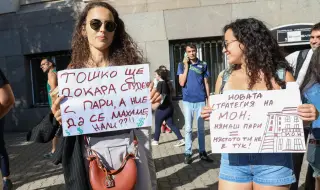
The sharp increase from 50 to 200% in fees for paid students a month before the start of enrollment for the 2025/2026 academic year caused protests due to their size and unilateral imposition, without any prior discussion of such a sensitive topic. Education Minister Krasimir Valchev tried to downplay the dissatisfaction with a numerical argument - for example, at Sofia University, nearly 900 out of a total of 20,000 students were affected. From a statistical point of view, the number may be small, but these are real people - it means 900 families will have to tighten their budgets and urgently find more money for the new fees in just one month. Where are the principles of accessibility of education going?!
“From the fall, our colleagues will not be able to cross the threshold of the university because they cannot afford a double higher fee”, announced organizers of the protests from the Faculty of Law, where the increase is more than twice - from 3250 leva to 6704 leva per year. The new fees are equivalent to 2-3 to 10 average salaries - for Bulgaria for the month of May the average salary is 2556 leva.
With changes to the Higher Education Act, the parliament is trying to change the scheme by which fees are now calculated, and immediately before the enrollment of students begins. Their amount is tied to state funding and the quality component. At first reading, the deputies approved changes that will reduce them by 25% of the already increased fee in the final vote. Dissatisfied students are demanding a 50 percent reduction.
However, during the protests, students also raised other demands, in addition to lower fees - a deep and quality reform of higher education, a national strategy for its development. However, politicians are not listening to them, as are the criticisms of why state universities both receive budget subsidies and have paid tuition - a discussion that has been going on for years with varying degrees of intensity.
Why not student loans
But why does no one advise young people to take out student loans, which were introduced as an option 15 years ago?
It turned out that they enjoy little popularity. According to data that Deutsche Welle received from the Ministry of Education, for the period 2010-2024, 22,415 loans were granted to students in state and private higher education institutions. The highest number was at the beginning of the program, when between 2-3 thousand people received funding annually (2010 - 2,837; 2011 - 3,972; 2012 - 3,600; 2013 - 3,134; 2014 - 2,463; 2015 - 1,871; 2016 - 1,131).
However, later their number dropped sharply, without changing the conditions for granting loans - from 760 in 2017 to 413 in 2021; 209 - in 2022; 219 in 2023 to only 186 for the past 2024. And the guarantees that the state grants to guarantee the repayment of loans to students and doctoral students are decreasing every year. For 2021, for example, they totaled up to 40 million leva, for 2024 they are 30 million. But the budget has paid off less than 10% of all loans granted - 1905, including 473 for the last four years.
However, there is one permanent trend that does not change, and it is that the largest number of students who have used state-guaranteed lending are studying in the specialties “Economics“, “Administration and Management“ and “Medicine”.
In general, however, Bulgarian students refrain from lending and there are several reasons. On the one hand, there is poor awareness, on the other - the loan is seen as a burden, not as an investment, given the uncertain labor market and work where part of the salary is in the gray sector. Its repayment must begin 6 to 12 months after graduation, and there is also an option for forgiveness upon the birth of a child. In addition, the maximum amount does not always cover real costs, especially in expensive specialties such as medicine, and young doctors receive low incomes.
Educational inequality
Only 18 months ago, the proposal of the “Denkov” cabinet to abolish fees for students on state orders angered the academic community and delighted the students, 90% of whom approved it. But it never came to be adopted.
“Education is a right, not a privilege!” - this was the inscription on one of the posters with which the students protested. In fact, in Bulgaria it becomes a privilege early on, even in primary education, when children enter the system of private lessons to fill in the deficits in their studies and prepare for various exams.
If higher education in our country costs more than that in prestigious Western universities, and at the same time guarantees weaker realization on the labor market and low incomes, why should young people choose Bulgaria?