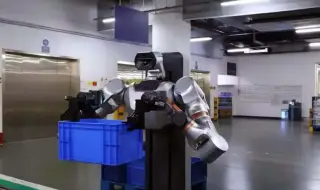
The world of industrial automation has entered a completely new era, and the static robotic arms of the past seem like relics of the past. The absolute global leader in the production of traction batteries CATL has announced the official launch of a strategic partnership with robotics pioneer Galbot. The result of this collaboration is already here: the heavy-duty humanoid robot Galbot S1 has left the glamorous showrooms and begun real, long-term autonomous work on the intelligent production line for battery packs and modules.
Unlike the numerous concept platforms that serve only for advertising, the Galbot S1 is a real workhorse. The machine is designed for brutal loads, with both its arms able to handle weights of up to 50 kilograms without any problems - a critical breakthrough for the sector. Equipped with a revolutionary vision system for centimeter-accurate positioning and a 360-degree obstacle avoidance scanner, the humanoid navigates the chaotic factory environment better than the average operator. This absolute synchronicity is vital in the delicate assembly of batteries, where perfect repeatability of movements and safety determine the quality of the final product.
The most curious detail in the Galbot S1 architecture lies in its “heart”. The robot is powered by specially developed batteries from CATL itself, which also serve as a technological showcase outside the automotive world. The cells use a cutting-edge particle sorting cathode, an innovative lithium anode with minimal energy consumption and a bionic, self-healing electrolyte. The result is 8 hours of continuous conveyor operation capacity and cell defect rates measured in the microscopic scale of PPB (parts of a billion).
However, the ambitions of the Asian conglomerate do not stop there. The agreement with Galbot envisages a global scaling of these systems with embedded artificial intelligence (Embodied AI). What's more - CATL has already integrated the intelligent humanoids into its own service network Ning Service, which was previously responsible for the inspection and recycling of car batteries. In this way, the company is setting future standards for after-sales service for such autonomous machines.
For the automotive industry, this is a clear signal: automation is becoming more flexible than ever. Galbot S1 is capable of taking on complex physical tasks that previously required a complete redesign of the assembly line. Of course, the mass penetration of artificial intelligence into heavy production will not happen overnight. True economic efficiency still depends on software training, the final price of the robot, security and maintaining an impeccable production rhythm. And although machines will not completely replace the human hand in the near future, the direction is irreversible – the batteries for tomorrow's electric cars are already being assembled under the watchful eye of a humanoid intelligence.