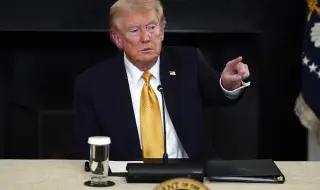
Late on Thursday, President Trump said he was ending trade talks with Canada, citing a television ad sponsored by the Ontario government that featured Ronald Reagan speaking negatively about tariffs, BTA reports.
"Based on their outrageous behavior, ALL TRADE NEGOTIATIONS WITH CANADA ARE TERMINATED", Trump wrote on social media shortly before 07:00 Bulgarian time.
The president claims that Canada "deceptively used an ad that is FAKE, featuring Ronald Reagan speaking negatively about tariffs". Trump has said the ad was intended to obstruct the Supreme Court and other courts as they review the legality of his sweeping tariffs.
The White House did not immediately respond to requests for more information.
The threat to end the talks is just the latest in a series of trade disputes between the U.S. and Canada — a months-long saga in which Trump has previously threatened to end the talks but has eventually changed his mind after concessions from Ottawa. The decision comes two weeks after Canadian Prime Minister Mark Carney visited Trump at the White House. While there have been some signs of progress, no concrete agreement has been announced.
Earlier in his administration, Trump imposed tariffs on Canada over drug smuggling allegations before exempting goods that were compliant with the U.S.-Mexico-Canada Agreement. He also imposed tariffs on Canadian cars, steel, aluminum and lumber as part of a global tariff push aimed at strengthening U.S. national security.
The ad in question was sponsored by the Canadian province of Ontario, and in it Reagan criticizes the tariffs, saying that they may seem patriotic, but "in the long run, such trade barriers hurt every American worker and consumer," leading to "fierce trade wars" and job losses. Ontario Premier Doug Ford said in a speech in Toronto earlier this month that the province would spend $53 million to run the ad on major U.S. networks.
It’s official: Ontario’s new advertising campaign in the U.S. has launched.
Using every tool we have, we'll never stop making the case against American tariffs on Canada. The way to prosperity is by working together.
Watch our new ad. pic.twitter.com/SgIVC1cqMJ
The ad uses an audio recording of a 1987 Reagan radio address. On Thursday night, shortly before Trump's comments, the Ronald Reagan Presidential Foundation and Institute said on social media that the ad misrepresented Reagan's address. The Ontario government did not seek permission to use the audio recording, the foundation said, adding that it was considering its legal options. The foundation did not specify what the inaccurate information in the ad was.
In the address from the Ronald Reagan Presidential Library, posted on YouTube, the former president detailed his commitment to free trade, saying that the then-decision to impose tariffs on Japanese semiconductors was an exception to his overall desire to reduce tariffs and trade barriers. Canada and the United States have been discussing in recent weeks how to reduce some of the tariffs that Trump has imposed on the United States' northern neighbor, specifically the 50 percent levies that Trump has imposed on Canadian aluminum and steel. The countries are also set to begin renegotiating the U.S.-Mexico-Canada Agreement in the coming months — a review that is legally required to take place in 2026.
Senior members of the Trump administration, notably Commerce Secretary Howard Lutnick, have proposed splitting the three-way pact into two separate bilateral agreements — an option that Trump has signaled he is open to but has not outright endorsed.
Ontario’s decision to feature Reagan in the ad is notable because of the former president’s strong influence among conservatives. The ad highlights Republicans’ longstanding support for free trade, with some exceptions — an ideology that Trump has begun to dismantle since his victory over Hillary Clinton in 2016. Trump’s return to the White House has accelerated the GOP’s move away from free trade, the paper said.
Ford, the leader of Ontario, is pushing for Canada to be more aggressive in its negotiations with the United States. He has said he is prepared to limit energy and mineral exports to the United States in retaliation. Ontario, Canada's most populous province, has recently lost jobs in the auto sector, as Stellantis and General Motors (GM) announced this month that they were pulling out of car production in the province, in part because of Trump's tariffs. Today, the Canadian government announced new restrictions on automakers. The decision provides for a significant reduction in import quotas for vehicles that benefit from preferential tariff relief. Under the new rules, the annual volume of the tariff relief quota for "General Motors" is being reduced by 24.2 percent and for "Stellantis" by 50 percent.