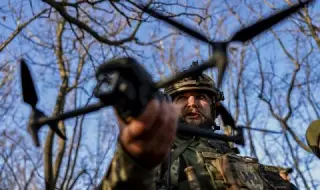
At a secret location in the Ukrainian countryside, scores of combat drones are being assembled at night in near-silence to launch strikes deep into Russian territory, the Associated Press reported, quoted by BTA.
Their targets are strategic - oil refineries, fuel depots and military logistics centers. Ukraine’s long-range drone campaign has intensified dramatically since the summer, hitting energy infrastructure across Russia and exhausting the country’s air defenses, the agency notes.
Made from parts produced in a wide network of workshops, these drones now fly much further than at any time since the war began.
Officers in flak jackets move with swift confidence, their headlights flashing red to stay hidden. The engines rumble like old motorcycles, their exhaust fumes wafting into the moonless night.
Minutes later, one after the other, the drones take off from a makeshift runway and head east. The strikes have caused a shortage of gasoline in Russia, forcing rationing in some regions and highlighting the growing vulnerability of the country's infrastructure, the AP reported.
Lieutenant General Vasyl Malyuk, head of Ukraine's Security Service, said on Monday that Ukraine has so far attacked about 160 refineries, pumping stations and other facilities in the Russian oil industry since the beginning of the year, DPA reported.
A total of 20 facilities were attacked in September and October, the head of the intelligence service in Kiev said. "They include six oil refineries, two oil terminals, three oil depots and nine oil pumping stations", Malyuk said, as quoted by the Interfax-Ukraine news agency.
According to Malyuk's estimates, the Russian market is missing about a fifth of the petroleum products it needs. He noted that Russia's oil refining capacity has been reduced by about 37%. Oil industry experts also estimate roughly the same figures, DPA notes.
Malyuk also said that Ukraine is targeting Russia's oil refining industry because it finances the lion's share of Russia's defense budget.
Meanwhile, Ukrainian President Volodymyr Zelensky has called for sanctions on another 340 tankers from Russia's "shadow fleet." The ships are used to export Russian oil, bypassing existing restrictions. Zelensky estimated that Russia could have a total of more than 1,500 such ships, flying various flags, DPA reported.
Western observers say that Ukrainian attacks on Russia's energy infrastructure have so far had a serious but not crippling effect. Ukrainian drones have repeatedly struck 16 major Russian refineries, accounting for about 38 percent of the country's nominal oil refining capacity, according to a recent study by the Carnegie Endowment, an American think tank cited by the Associated Press.
However, the study found that the real impact was much more limited - most plants resumed work within weeks, and production of refined products in Russia was compensated by unused capacity and existing fuel surpluses.
However, the deep strikes gave Kiev the initiative at a crucial moment, the AP notes. The United States and Europe are tightening sanctions on the Russian oil industry, even though Ukraine's request for American Tomahawk missiles long-range strike is stalled.
President Volodymyr Zelensky says Ukraine's improved long-range strike capabilities are doing real damage, forcing the Kremlin to import fuel and limit exports. "We estimate that they have lost up to 20% of their gasoline reserves - directly as a result of our strikes," Zelensky told reporters at a briefing in Kiev.
At the secret launch pad, the commander leading the operation - a broad-shouldered man identified only by the call sign Fidel in accordance with Ukrainian military regulations - watches through night-vision goggles as the drones soar into the starry sky.
"Drones are evolving," Fidel told The Associated Press. "Instead of flying up to 500 kilometers, now they fly up to 1,000... Three factors are needed for a successful operation - drones, people and planning. We want to achieve the best results. For us, this is a sacred mission," the Ukrainian commander added.
A large part of Ukraine's drone fleet is domestically produced. The "Lyuty", the leading drone model for night attacks, is a waist-high unmanned aerial vehicle with a sausage-shaped body, a fin at the back and a distinctive triangular tail.
It looks neither elegant nor threatening - it looks more like a product from Home Depot, one of the largest American chains of building materials, than a product of the defense company Lockheed Martin. But the ease of assembly means that the "Lyuty" drone can be concealed and constantly improved - optimized to sneak through the tightly monitored airspace of the front line.
Typical of the Ukrainian philosophy of no-frills military production, the "Lyuty" (whose name means "fierce" in Ukrainian) has become a symbol of national pride and was recently featured on a postage stamp in Ukraine.
The range of these drones - with some models doubling their range in the past year to routinely attack targets within 1,000 kilometers of the border - marks a shift in the geography of the conflict, the AP points out. The attacks a year ago damaged refineries at a much smaller range, mostly in Russia's western border regions. Costs have also fallen, putting expensive air defense systems under strain, with Ukraine now producing long-range drones for as little as $55,000.
"What we are seeing is that Ukraine is getting better at bringing the war to Russia," said Adriano Bossoni, director of research at global risk analysis firm RANE, based in New York. "For most of the war, Russia assumed its own territory was safe. "It's no longer the case," he added.
The strategic logic is attrition through logistics, Bossoni argues - by forcing Russia to reroute supplies and engage air defenses over a wider area, Kiev is seeking to reduce Moscow's ability to sustain large-scale operations.
The Paris-based International Energy Agency (IEA) says repeated drone strikes have reduced Russia's oil refining capacity by about 500,000 barrels per day. This has caused fuel shortages on the domestic market and limited exports of diesel and jet fuel, even though total global oil production remains resilient and prices are stable.
Kiev's own strike capabilities allow for independent drone launches, bypassing the Western approval required to import long-range weapons. This autonomy preceded the tougher sanctions against Russia - the allies escalated their actions only after Ukraine spent months striking Russian refineries, the AP notes.
Virtually every mission is a lesson in compromise, the AP notes. Fewer than 30% of drones reach the target area, so meticulous planning is necessary, Fidel said, reflecting on the human cost. "The war has fallen on our generation so that we can fight for our children and so that they can live in a free, democratic country," he said. "We are currently gaining experience that will be used by every country in the world, and we are paying the price with our lives and the lives of our friends," Fidel concluded.