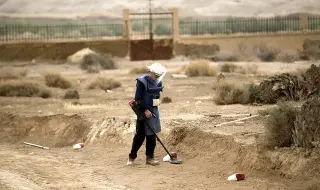
26 years ago, NATO used depleted uranium ammunition in the Kosovo war. Many soldiers subsequently fell ill with cancer, few were paid compensation. In Kosovo, however, the poison still lingers in the soil to this day.
"I remember that day very clearly", says Emerico Maria Lacetti, a former colonel in the military department of the Italian Red Cross. During the Kosovo war in 1999, he was in Albania, just a few hundred meters from the border with Kosovo. There, he was commander of a hospital for refugees from the province, which was then part of Serbia. "We stood on containers and watched the bombing - it was like some kind of perverse New Year's fireworks. The shock wave was felt even at a great distance. But we were not informed about the specific dangers of the weapons used."
Since March 1999, NATO has been intervening in the years-long Kosovo conflict with Operation "Allied Force". Within 78 days, the Alliance carried out flights with over 1,000 aircraft against the security forces of Serbia. According to official data, over 28,000 explosive devices were used, including those containing uranium, which is suspected of causing cancer.
These ammunitions have a core of depleted uranium, which, due to its high density (three times greater than that of lead), has a high penetrating power and is therefore used mainly against tanks and other armored targets. However, the attacks can create fine uranium dust that disperses and can be harmful to health, for example if inhaled.
NATO rejects the accusations
On this occasion, NATO only issued a written position, stating that the Alliance takes "health and environmental issues very seriously." A specially established commission on the effects of the exploitation of depleted uranium munitions in Kosovo concluded that "there was no lasting risk to the population." UN reports, for example from 2014, are cited as evidence.
However, this contradicts the decisions of Italian courts in connection with the complaints of about 500 veterans of the Kosovo War who fell ill with cancer.
Laschetti says that his hospital on the border with Kosovo was practically in the "hot zone" - in the immediate vicinity of an active conflict, and this always poses risks.
When Lacetti returned home in July 1999, he had difficulty breathing, which is why he underwent a medical examination. It turned out that he had an aggressive lymphoma in his lungs, i.e. a malignant tumor measuring 24 by 12 by 14 cm.
Initially, the treatment was successful, but in 2008 Lacetti fell ill with cancer again. “They found an unusually large amount of perfectly round ceramic particles, as if baked in a kiln.” The conclusion is clear: the particles had accumulated in his body over the years and could have caused new injuries.
The complaints are successful
Lacchetti understands that other soldiers who were in the same places had received the same diagnoses. He gets in touch with them and through the lawyer Angelo Tartaglia, 500 former soldiers successfully condemn the Italian state. Among them is Lacetti, whom a court in Rome certified in 2009 that he had become a victim in the performance of his official duties. The court also awarded him compensation. But this did not make him healthy again. "Confession does not remove particles from the lungs or kidneys", says Emerico Maria Lacetti bitterly.
After the war in Kosovo, a commission of the Italian Ministry of Defense set out to study the link between explosions with depleted uranium munitions and cancer. It found a statistically significant excess of non-Hodgkin lymphoma in the affected soldiers. However, other studies, such as a report by the World Health Organization (WHO) from the same year, did not find unequivocal evidence of a direct link between depleted uranium munitions and individual cases of cancer.
ADVERTISEMENT
The difficult proof
Wim Zwinenburg, a member of the International Coalition to Ban Uranium Weapons, believes that the case is clear. "The judge recognized that the Italian state had a duty to exercise preventive care, which is why compensation was awarded," explains the expert. He has been studying the use and consequences of depleted uranium munitions for over 16 years.
"My conclusion is that it is extremely difficult to make a definitive statement, because depleted uranium only affects the body when it enters the body, in most cases in the form of fine dust particles that are inhaled. But the exact amounts of dust inhaled have never been measured - there are only a few reliable long-term studies." The causes of cancer are often difficult to identify unequivocally. An unhealthy lifestyle, environmental influences, genetic predisposition and many other factors also play a role.
"Proving is difficult", assures Zwinenburg. "Have those affected ever touched a depleted uranium grenade or been near a contaminated tank? Uranium can take a year to penetrate the skin. When things are not clear-cut, doctors cannot commit to concrete conclusions. But people are looking for a clear reason, but the reality is far more complicated," he points out."
Uranium munitions were also used by the US in Iraq in 2004. Photo: STAN HONDA/AFP/Getty Images
Mandatory decontamination
In 2002, the UN adopted a resolution that obliged countries to inform countries where uranium munitions had been used and to help them clean up contaminated areas. But it is not known to what extent NATO complied with this requirement in Kosovo - no information was provided. Field visits show that in many parts of Kosovo, the population is largely unaware of the risks, and decontamination efforts - with one exception in the village of Ludbunari - have not been undertaken.
"NATO can be accused of using such weapons, but to a much greater extent - of not cleaning up after the war. There are clear protocols for protecting soldiers, but not for civilians. It is unacceptable to use toxic munitions and then just leave," Zwinenburg points out.
Officially, the material that makes up depleted uranium munitions is classified as low- to medium-level radioactive waste. But "in humid climates like the Balkans, the shells can corrode and disintegrate, leaving dangerous residues," Zwinenburg says. In this regard, time does not help either, since the decay period of uranium is almost infinite. According to Zwinenburg, this is a manifestation of the double standards of states.
"If such a grenade were to be found, for example, in a park in the Netherlands, the area would be immediately cordoned off, special forces in special clothing would come and take the grenade to a safe place. That is, if it concerns the own population, the risks are taken seriously - but not elsewhere.
Lacchetti is disappointed that his case and the cases of many other veterans have not led to any substantive changes. "Uranium ammunition is still legal. We have tried in every possible way to achieve their ban. But we have failed," he admits.