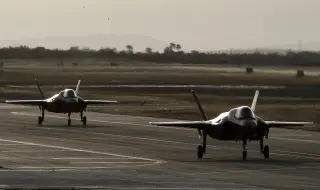
The administration of President Donald Trump is considering Saudi Arabia's request to buy up to 48 F-35 Lightning II fighter jets, two sources familiar with the negotiations told "Reuters". If approved, the deal would represent one of the largest arms contracts in the history of the two countries and a significant turn in US military export policy in the Middle East.
According to the sources, the Pentagon has already given its initial approval, and the issue has moved to the level of the Secretary of Defense. Additional government and congressional approvals are still pending before a final decision is made.
The sale of the F-35 to Riyadh would mean a serious redistribution of the military balance in the region and would test the traditional American policy of ensuring Israel's "qualitative military superiority". So far, Israel is the only country in the Middle East to have this type of fighter.
Manufactured by Lockheed Martin, the F-35 is a fifth-generation stealth fighter capable of avoiding radar detection and performing both combat and reconnaissance missions.
Israel already has several squadrons of this aircraft, which are actively used for missions in the region.
Saudi Arabia has been seeking to include the F-35 in its fleet for years as part of the broader "Vision 2030" program. Crown Prince Mohammed bin Salman's economic and military modernization drive. The Royal Air Force currently operates American F-15s, as well as European Tornado and Typhoon.
Riyadh sees the acquisition of the F-35 as a response to growing threats from Iran and a tool to strengthen its regional position. According to "Reuters", the request for 48 aircraft corresponds to the formation of two full squadrons.
Negotiations on the F-35 with Saudi Arabia have been ongoing for years. Under Joe Biden, an option was discussed in which the provision of the aircraft would be part of a broader agreement to normalize relations between Riyadh and Israel, but the process then stalled.
However, after Trump returned to the White House, the United States changed its tone, and the president put military cooperation with the kingdom among his priorities. In May, Washington and Riyadh signed a $142 billion arms deal, billed as the "largest defense deal in U.S. history".
Despite the progress, the F-35 sale is likely to face strong congressional resistance. Some lawmakers continue to oppose new arms sales to Riyadh after the 2018 murder of journalist Jamal Khashoggi and raise questions about human rights and regional stability.
For Washington, such a deal would strengthen its strategic partnership with Saudi Arabia and provide an opportunity to limit Chinese and Russian influence in the region. But it would also test the U.S. commitment to Israel's security.