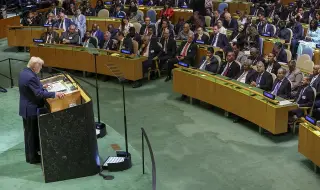
The world press commented today on the decision of the UN Security Council to support Trump's plan for the Gaza Strip.
The US achieved a major breakthrough, noted the American newspaper "New York Times", recalling that Russia and China, permanent members of the UN Security Council with veto power, abstained. The thirteen votes "for" and not one "against" give legal support to the Trump administration's strategy for the future of the Palestinian enclave devastated by the two-year war between Israel and the radical Palestinian group "Hamas", the publication points out.
The Security Council resolutions are legally binding and although there is no mechanism for their implementation, the UN can impose sanctions on countries that do not comply with them.
The vote in the Security Council was also a major diplomatic victory for the Trump administration, the "New York Times" emphasizes. Over the past two years, while the conflict between Israel and "Hamas" was ongoing, Washington was isolated at the UN because of its strong support for Israel, the newspaper recalls.
The newly adopted resolution calls for the entry of an International Stabilization Force to demilitarize the Gaza Strip. The proposal, which contains Trump's 20-point ceasefire plan, also envisages the creation of a Peace Council to oversee the peace plan, although the composition of the council is not specified, the American publication notes.
Russia and China abstained, apparently influenced by the support for the resolution by a number of Muslim countries - Egypt, Jordan, Qatar, Saudi Arabia, the UAE, Indonesia, Turkey and Pakistan, which is also a non-permanent member of the Security Council, the "New York Times" indicates.
However, the road ahead is filled with many uncertainties - Israeli strikes in Gaza continue, and clashes are taking place in the West Bank, the newspaper notes. The appointment of members of the Peace Council, the body responsible for overseeing the transition in Gaza, and clarification under whose authority the stabilization forces will operate are pending. The resolution emphasizes that if the Palestinian Authority, which administers parts of the occupied West Bank, undergoes reforms and the reconstruction of the devastated Gaza Strip progresses, the conditions may finally appear "for a credible path to self-determination and statehood for Palestine," the American publication emphasizes.
"Hamas" rejected the resolution, stating that it "does not meet the demands and human and political rights" of the Palestinians, notes the French newspaper "Figaro". "The resolution imposes a mechanism for international guardianship over the Gaza Strip, which our people and its factions reject", the armed Islamist movement stated, quoted by the publication. According to "Hamas" this is "a mechanism to achieve Israel's goals". The Islamist movement also regrets the creation of an international force whose "mission includes disarming" Palestinian groups in Gaza.
At the same time, Trump welcomed the resolution, saying it would lead to "more peace in the world," Le Monde reported. "This vote will remain one of the most important in the history of the United Nations," the US president said in "Truth Social," thanking the Security Council members, including Russia and China, who abstained.
Russia proposed its own resolution, justifying its initiative by the fact that the US resolution does not go far enough on the issue of Palestinian statehood, another French newspaper, Le Figaro, noted. Moscow confirmed its "unwavering commitment" to supporting the two-state solution. Its draft resolution did not authorize the creation of a Peace Council or the deployment of international forces.
The purpose of creating such forces is to guarantee security in the devastated Palestinian enclave, notes the British newspaper "Independent". The envisaged stabilization force would have broad powers, including border surveillance, as well as ensuring security and demilitarization of the territory. The authorization for the Council and the force expires at the end of 2027, the publication points out.
Muslim countries that have expressed interest in providing troops for the international force have made it clear that Security Council authorization is essential for their participation, the British newspaper recalls.
The price for the support of the Islamic world, which is expected to provide peacekeepers for the future International Stabilization Force, was a mention of an independent Palestine in the resolution, the British newspaper "Guardian" notes. This was a compromise with the original US draft, which did not mention the creation of a Palestinian state at all.
However, the text is vague and evasive, promising only the possibility of such an event once the Palestinian Authority is reformed and the reconstruction of Gaza progresses, the Guardian notes. Both Islamic and European countries wanted a firmer commitment, but in statements after the vote, representatives of the countries in question said they were ready to accept the compromise in the name of extending the ceasefire and being able to feed and protect the 2.2 million Palestinians in Gaza.
A day before the UN vote, Israeli Prime Minister Benjamin Netanyahu reiterated his government's firm opposition to the creation of a Palestinian state. This raised the question of whether Israel would allow the implementation of the UN-backed proposals, the Guardian points out. "Hamas" for its part, condemned the vote and said it would not disarm, the British publication notes, recalling that, according to supporters of the resolution, it should lead to the lifting of the last barriers to the flow of humanitarian aid to Gaza.
However, many difficulties remain - no country has publicly expressed its agreement to join the International Stabilization Force, Gazans remain completely dependent on international humanitarian aid to survive, and the Hamas group, although weakened by Israel's devastating offensive, retains control over almost half of the besieged enclave, the British newspaper "Financial Times" indicates. It is still unclear how the key points of Trump's plan, including the disarmament of "Hamas" and the possible withdrawal of Israeli forces from the strip, will be implemented, the newspaper indicates.