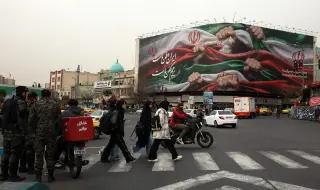
Iranian authorities are considering restoring the country's internet, a senior government official said today, quoted by Reuters, BTA reported.
He said this after authorities cut off telecommunications while using massive force to suppress protests, which are part of the country's biggest unrest since the 1979 Islamic Revolution.
Iranian state TV, meanwhile, was the target of a hacker attack last night, briefly broadcasting speeches by US President Donald Trump and the son of Iran's last exiled shah, Reza Pahlavi, who called on the public to revolt.
Reuters calls this another sign of the weakening of the authorities' control over the situation in the country.
The unrest in Iran has subsided for nearly a week, according to authorities and social media posts, after anti-government protests that erupted late last month were suppressed after three days of mass violence.
An Iranian government official told Reuters that the confirmed death toll was more than 5,000 people, including 500 security personnel. Some of the worst unrest has occurred in the Kurdish-populated areas of the country's northwest. Western-based human rights groups focusing on Iran also put the death toll in the thousands.
The US news agency "Human Rights Activists" (Human Rights Activists News Agency, HRANA) reported today that most of the injuries to protesters were caused by bullets fired at the faces and chests of demonstrators, which resulted in blindness, internal bleeding and organ damage.
State television reported that arrests were continuing in Iran, including in Tehran, the southern city of Kerman and Semnan, located south of the capital. It said that those detained included those it described as agents of Israeli terrorist groups.
Opposition activists accused authorities of opening fire on peaceful demonstrators to quell the unrest. The Islamic Republic's religious leaders say groups of armed men incited by foreign enemies have attacked hospitals and mosques.
The total death toll in the protests is significantly higher than previous anti-government unrest, which was suppressed by authorities in 2009 and 2022.
The violence has prompted repeated threats from Trump of military intervention, although the US president has refrained from doing so after the mass killings stopped.
Trump's warnings have raised fears among Gulf states of a greater escalation, which has led to intensive diplomacy with Washington and Tehran. Iran's ambassador to Saudi Arabia, Alireza Enayati, said today that "igniting any conflict will have consequences for the entire region."
Iran's telecommunications, which include the internet and international phone lines, were largely disrupted in the days leading up to the major unrest. Access to some internet services has since been restored, leading to reports of widespread attacks on protesters.
The non-governmental internet monitoring group "Netblocks" said today that data showed minimal internet connectivity, but that temporarily restricted internet access allowed some messages to be published, suggesting that authorities were trying to impose tighter restrictions on internet access.
Ebrahim Azizi, chairman of the parliament's national security and foreign policy committee, said that top security services would restore internet access in the coming days, with internet services being available again "as soon as security conditions allow."
Another hardline lawmaker, Hamid Rasai, said authorities should have heeded earlier complaints from Supreme Leader Ali Khamenei that "cyberspace is too loose."
During yesterday's hack of state television, a segment lasting several minutes was broadcast on television screens titled "the real news about the Iranian national revolution." Messages were also delivered from Reza Pahlavi, the son of the last Iranian shah living in exile in the United States, who called for an uprising to overthrow the Shiite Muslim clerics who have ruled the country since the 1979 revolution that toppled Reza's father, Mohammad Reza Pahlavi.
Pahlavi has become a leading voice of the opposition and has stressed his intentions to return to Iran, although it is difficult to ascertain how strong his support is within the country, Reuters notes.