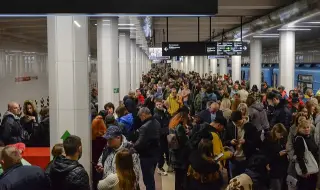
Life in Kiev continues - despite the massive Russian attacks that caused power and heating to be cut off. What is happening in the city? And how are people coping?
The residents of Kiev are in a terrible situation - due to power, water and heating cuts as a result of Russian shelling. The situation is further aggravated by extremely low temperatures. How is life in the Ukrainian capital under these conditions?
Thousands of multi-storey buildings are without heating. It's -12°C outside.
Kiev has been struggling with the consequences of massive Russian attacks on energy infrastructure for the third week in a row. As of January 22, according to Kiev Mayor Vitali Klitschko, about 2,600 households in the capital remain without heating. The temperature these days is holding at -12°C.
It's not surprising that many people have left the city under such conditions. Anastasia's family is among them. "Due to the lack of heating, electricity and water, our entire family - my husband, me and our two children - went to my parents' cottage. My father will also come," says Anastasia. Their cottage is heated by gas, and if necessary, a diesel generator can be turned on in the yard. "Then we have electricity, water and heat. We get the water from the well. "When the generator is working, there is electricity and the pumps are working," the woman says.
Anastasia works as a beautician, her schedule depends on the clients. That's why she can take a leave of absence and leave the city. However, her husband works in Kiev and travels two hours to his workplace every day.
The Kiev writer and translator, who writes under the pseudonym Tamara Zernyshko, also left the capital on the eve of the latest massive shelling from Russia. She says she saw on Facebook that a hotel owner in the Lviv region was offering a 50% discount on accommodation for people from Kiev, and she left with her children. Tamara is happy to have found this option, because at the moment her home has no water or heating.
No school and universities
The winter vacation in most educational institutions in the Ukrainian capital, with the exception of kindergartens, has been extended until February 1. The government believes that cutting off power to large facilities will save energy and redistribute it to residential buildings.
However, there are still people in some of the student dormitories - those who have not been able to return home because they are working. There are also problems with lighting there at the moment. There is water and heating for now.
The mayor of the capital, Vitali Klitschko, said in an interview with the "Agence France-Presse" agency that after the Russian attacks on January 9, out of a total of 3.6 million people living in the city, approximately 600,000 have left. This figure, as explained by the mayor's press service, is based on data from mobile operators - currently in the capital "they are" 600,000 fewer phones.
However, the Kyiv City Military Administration says that this figure is "not confirmed". "If so many subscribers who are provided with electricity services had left the city, then the electricity situation would probably not be so critical," said KMVA spokeswoman Ekaterina Pop.
However, this argument does not necessarily correspond to reality, analysts believe. "One way to assess it is indeed the level of electricity consumption. But at the moment, electricity is supplied very irregularly, and the schedules for power outages are not observed. "That's why when the electricity comes back on, there's excessive consumption - people immediately turn on the washing machine, cook food," explains Roman Nitsovich from the Dixie Group analysis center.
How do you live with children like that?
The situation in Kiev remains critical - regardless of the number of people who have left the city. Anya Sirotenko has remained in the capital and is struggling with the challenges in the city. The young woman moved from the occupied part of the Kherson region and in these difficult times lives alone with her three-month-old baby in a multi-storey building. Her husband has been mobilized. "I live on the 15th floor. There is rarely electricity. And when there is no electricity, there is no water," she says.
Anya says it's good that she is still breastfeeding her baby. She has a tourist gas stove with which she heats water to bathe him. The young mother would like to move somewhere outside of Kiev, but she doesn't have the financial means. "I'll hardly be able to find housing at the price I'm paying now."
The situation is similar in Marta Semenyuk's family. "Due to the shelling and problems in our house, there has been no heating in some pipes since December 3. To keep warm, we turn on the gas oven. When there is electricity, we turn on the air conditioner and put a fan that blows the heat around the apartment", the woman says.
Marta says that they do not send their child to kindergarten because the temperature there is between 11 and 13 degrees. Now she takes her son to work because her company's office has a generator and it is warm.
Against the backdrop of the complicated situation after the latest Russian shelling, local authorities have provided hot meals for vulnerable categories of the population - in particular, pensioners and people with disabilities. And volunteers are helping with the distribution. "With our cars, we deliver hot lunches to apartments where elderly people and people with disabilities live. "I myself deliver about 115 lunches every week," says Nikolay Dyachenko, who heads a self-organization group for the population in one of the districts of Kiev.
How long will there be no heating?
According to Roman Nitsovich from the analytical center DiXi Group, currently about 20 percent of the housing stock in the Ukrainian capital remains without heating.
Where pipes or radiators have burst, there may be no heating until spring, Nitsovich believes. "If the coolant has not been drained and the pipes have frozen, in order to start this system, it is necessary to completely replace the heating system in the house".