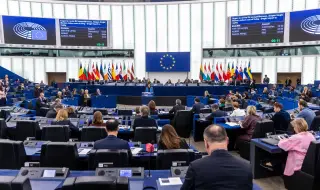
The European Parliament today approved a package of financial measures for Ukraine, including a loan from the European Union in the amount of 90 billion euros for 2026 and 2027, changes to the EU mechanism for Ukraine and an amendment to the multiannual financial framework for the period 2021-2027, so that the EU budget reserve can be used as a guarantee for the loan and to cover debt service costs, BTA reported.
The loan for Ukraine was approved with 458 votes “for“, 140 MEPs voted “against“, and 44 abstained. The changes to the mechanism for Ukraine were approved by 473 votes in favour, 140 against and 32 abstentions. The amendment to the multiannual financial framework was approved by 490 votes in favour, 130 against and 32 abstentions.
The package is part of the implementation of enhanced cooperation between 25 member states and aims to provide predictable, continuous and flexible financial support to Kiev in the face of continued Russian aggression and growing needs for reconstruction and defence financing.
The regulation adopted today provides for the creation of a “Loan in Support of Ukraine“ for 2026-2027, financed by borrowing from the European Commission on the capital markets. The loan will have limited recourse and will become due upon the occurrence of certain conditions, including receipt by Ukraine of reparations from Russia or established violations related to fraud or corruption.
The funds will be channelled under several lines – as budget support in the form of macro-financial assistance, as well as support for the capacity of the Ukrainian defence industry. Within the framework of the macro-financial assistance, the Commission will negotiate a memorandum of understanding with the Ukrainian authorities containing specific conditions for reforms, including strengthening revenue mobilisation, improving public finance management and measures against corruption.
Under the defence support line, urgent and large-scale public investments are foreseen for the modernisation of the Ukrainian defence technological and industrial base, as well as closer integration with the European defence industry. The regulation sets out detailed eligibility requirements for manufacturers and subcontractors, including conditions for establishment in the EU, European Economic Area countries or Ukraine, restrictions on the participation of third countries and rules for the protection of sensitive and classified information.
Ukraine will have to open a special account to manage funds related to defence support and provide monthly reports on payments made. The European Commission will have monitoring and control rights, and the European Parliament and the Council will be regularly informed of the progress of implementation.
The financing of the loan will be implemented through a diversified borrowing strategy, with debt servicing costs being borne by the EU budget through a dedicated instrument above the ceilings of the multiannual financial framework.
The proposal also provides for the possibility for the Union to use blocked Russian assets in the EU to repay the loan, in full compliance with EU and international law.
According to the legislative justification, the objective of the initiative is to support Ukraine's macro-financial stability, alleviate its external and internal financial constraints and strengthen the capacity of its defence industry in response to the ongoing war.
The package also includes amendments to the 2021-2027 multiannual financial framework to allow the use of the budgetary reserve as a guarantee for the loan and ensure coverage of related costs.
What preceded the new decision?
Russia's increased aggression has increased Ukraine's financial needs and requires urgent investments in Ukraine's technological and industrial defense base. The financing required for 2026 and 2027 is expected to exceed previous International Monetary Fund (IMF) forecasts, requiring additional support from both the European Union and the international community.
On September 9, 2025, Ukraine submitted a formal request for a new IMF program for the period 2026-2029. The Fund's ability to continue with the program depends on the provision of sufficient financing guarantees from international partners, including the EU.
On 18 December 2025, the European Council agreed to provide Ukraine with a loan of €90 billion for 2026-2027, financed by EU borrowing on capital markets and backed by the Union's budgetary reserve. It was agreed that the instrument would be implemented through enhanced cooperation under Article 20 of the Treaty on European Union, so that the mobilisation of budgetary resources as a guarantee for the loan would not affect the financial obligations of the Czech Republic, Hungary and Slovakia.
On the same date, 25 Member States agreed that the loan would only be repaid by Ukraine after receiving war reparations. Until then, the assets of the Russian Central Bank remain blocked, with the EU reserving the right to use them to repay the loan in accordance with Union and international law.
The participating countries stressed that the instrument should contribute to strengthening the European and Ukrainian defence industries, to continuing reforms and the fight against corruption in Ukraine, and to taking into account the specific nature of the security and defence policies of individual Member States.
In view of Ukraine's difficult financial situation and the need for the country to have resources to counter Russian aggression and for recovery, the EU envisages additional financial assistance to help cover urgent needs and implement the future IMF programme.
Following the vote in Parliament, the legislative process between the institutions is to be finalised. According to the Commission, the aim is to adopt the legal acts quickly enough to allow disbursement to start in the second quarter of 2026; According to diplomats quoted by Reuters, the first payment is planned for early April, once the Commission starts raising funds from the markets.