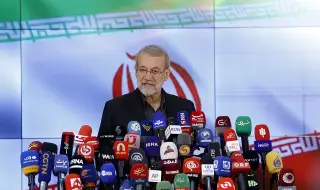
Veteran Iranian politician Ali Larijani said today that an interim governing council will be formed after the country's Supreme Leader Ayatollah Ali Khamenei was killed in an air strike. Over the past year, Larijani has re-emerged as one of the most influential figures in the security sphere.
He is a member of the inner circles of power and comes from one of the country's leading clerical families. Larijani oversaw Iran's efforts to reach a nuclear deal with the United States. In January, just a month before he took up the job, Washington imposed sanctions on him over his alleged involvement in the bloody crackdown on anti-government protests.
Larijani accused the US and Israel of trying to divide and plunder Iran and threatened "separatist groups" with a harsh response if they tried to take any action, Iranian state television reported on Sunday - nearly 24 hours after both sides launched a series of attacks on the Islamic Republic.
Iran's Armed Forces Chief of Staff, Abdolrahim Mousavi, was also killed in the strikes, Iran TV reported.
Larijani, who was appointed secretary of the Supreme National Security Council (SNSC) in August, has held many senior positions throughout a career marked by loyalty to Khamenei. Larijani has a reputation for maintaining pragmatic relations with often-warring factions within the system.
He solidified his status as Khamenei’s trusted strategist last month when he visited the intermediary country of Oman to prepare for indirect nuclear talks with the United States, as Washington massed military forces in the Middle East in an attempt to force Iran to agree to concessions before strikes.
In addition, Larijani has made several visits to Iran’s key ally – Moscow to discuss a range of security cooperation issues, another sign of his return to high-level diplomacy.
LARIJANI THINKS NUCLEAR ISSUE "IS SOLVABLE"
Larijani, who previously headed the Supreme National Assembly for 20 years, returned to the top job after the 12-day air war between Iran and Israel, in which the United States also participated. Larijani has officially returned to the core of the established security elite.
Some of his public statements on the nuclear issue have sounded pragmatic. "In my opinion, this issue is solvable," Larijani said last month on Omani state television, referring to the talks with the United States. "If Americans are concerned that Iran should not seek nuclear weapons, that issue can be resolved," he added.
But after Iran was gripped by anti-government protests in January, Washington condemned his role on the National Security Council.
Larijani "was at the forefront of efforts to quell the wave of demonstrations that swept Iran in January," the US government said in a statement. The text detailed the sanctions that were imposed on Larijani and other officials for their crackdown on protesters.
"Larijani was among the first Iranian leaders to call for a violent response to the legitimate demands of the Iranian people," the US Treasury Department said in a statement released on January 15. The text states that Larijani acted on Khamenei's orders.
Human rights groups say that thousands of people were killed in the crackdown on the protests. It was the worst internal unrest in Iran since the 1979 Islamic Revolution.
"HORSE FOR A CHICKEN"
Like other Iranian officials, Larijani expressed understanding for the demonstrations sparked by economic hardship. However, he condemned the armed actions, which he said were incited by Iran's main enemy, Israel.
"Popular protests must be completely separated from terrorist groups," Larijani wrote in a publication distributed by state media on January 10. "Those participating in the unrest are an urban quasi-terrorist formation," he said on January 26.
Larijani is a former member of Iran's Islamic Revolutionary Guard Corps and was the chief negotiator in the nuclear talks between 2005 and 2007, defending Tehran's right to enrich uranium. He once called European incentives to abandon nuclear fuel production "a horse for a chicken." But Iranian analysts at the time said he was trying to maintain a diplomatic approach to the West and was seen as a pragmatist.
The United States and Israel believe Iran is seeking to develop nuclear weapons that could threaten Israel's existence. Iran says its nuclear program is entirely peaceful.
Larijani served as parliament speaker from 2008 to 2020.
While in that position, in 2015, after nearly two years of delicate negotiations, Iran reached a nuclear deal with six world powers. In 2018, during his first term, President Donald Trump withdrew the United States from the hard-won agreement.
INTERACTION WITH PUTIN
Larijani warned that Iran's nuclear program "can never be destroyed." "Because once you have the technology, they can't take that discovery away," he said on PBS's "Frontline" program last September. "It's like being the inventor of a machine and having the machine stolen. You can rebuild it," Larijani added.
He has visited Moscow many times and met with President Vladimir Putin, helping Khamenei maintain a key ally and a world power that acts as a counterweight to the pressure exerted by Trump.
Larijiani has also been tasked with making progress in talks with China. In 2021, his efforts led to the conclusion of a 25-year cooperation agreement.
He later tried to run for president in 2021 and 2024, but was removed both times by the Guardian Council, which cited concerns about his lifestyle and family ties abroad.
Larijani was born in 1958 in the Iraqi city of Najaf to a leading Iranian cleric and moved to Iran as a child. Larijani has a doctorate in philosophy. Several of his brothers also hold senior positions in the state administration, including in the judiciary and the foreign ministry.
One of Larijani's daughters was removed from her teaching position at Emory University's School of Medicine in January. in the US state of Georgia, following protests by Iranian-American activists angered by her father's role in suppressing demonstrations in Iran.
Translated from English: Nikolay Velev, BTA