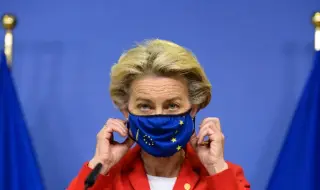
Ursula von der Leyen regrets that Europe has turned its back on nuclear power. "I think it was a strategic mistake for Europe to give up a reliable and affordable source of electricity with low emissions."
European Commission (EC) President Ursula von der Leyen described the move away from nuclear power in Europe as a "strategic mistake". "I believe it was a strategic mistake for Europe to turn its back on a reliable and affordable source of low-emission electricity", said the EC President at the start of the second International Nuclear Energy Summit, which is taking place near Paris.
She regretted the decline in the share of nuclear energy in the European energy mix. In 1990, around a third of European electricity was nuclear, and today it is only 15%, Ursula von der Leyen stressed.
EC develops new strategy for small modular reactors
There is a global renaissance of nuclear energy, she said, adding that the EU wants to be part of this process and that the EC is already developing a new strategy for small modular nuclear reactors (SMRs). This new technology should be developed by the early 2030s and play a key role in energy supply, alongside conventional nuclear reactors.
Von der Leyen announced that the European Union would provide guarantees of 200 million euros for private investors investing in new nuclear technologies. "The funds for this will come from emissions trading", she said.
The host of the conference, French President Emmanuel Macron, is advocating for better financing options for new reactors. He is pushing for more investment in the development of small modular reactors (SMRs). "Our American friends, the Canadians and the Chinese are at the forefront of these innovations, the Europeans must stay in the race," the French president added.
Macron also called for better energy cross-border cooperation. A market for the free movement of emission-free electricity is needed. It does not matter whether the electricity is produced from wind, solar or nuclear power, he said.
No German government representatives
The nuclear energy summit is attended by representatives of around 40 countries and organisations. No German government representatives are expected to attend.
Germany closed its last nuclear power plants in April 2023. In the years-long dispute over EU funding for nuclear power, Germany moved closer to France's position in May 2025. At the time, Economics Minister Katharina Reiche (CDU) was open to the idea of funding research into small modular nuclear reactors from the EU budget.
Federal Environment Minister Carsten Schneider (SPD) once again rejected the idea of building new nuclear power plants in Germany. This is the wrong approach, Schneider said in an interview with radio rbb24.
"Germany was right to abandon nuclear power. We are developing renewable energy sources extremely quickly," he stressed. Schneider rejects both SMR reactors and their EU funding. In his opinion, small reactors are "just as dangerous and even less efficient".