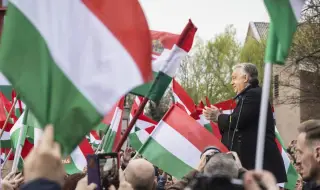
Hungary is entering the final stage of the parliamentary election campaign with the feeling that this time things may end differently. The ratings of the ruling Fidesz party are falling, while the opposition Tisza party of Peter Magyar is ahead of Viktor Orban's party by 8-12%, delfi.lt writes in its analytical material.
It seems that the Kremlin and the Hungarian prime minister himself are well aware of this, which is why the Russian side is doing everything possible to increase Fidesz's ratings and preserve Orban's power. As reported by The Financial Times, the consulting agency Social Design Agency has developed a social media campaign designed to improve Orban's chances in the elections and undermine his key rival Peter Magyar.
The media component of the information operation is led by key figures in Moscow. Andrey Yarin, head of the “Domestic Policy” Directorate of the Presidential Administration, is the head of the team. Among the team members is Grigory Kazankov, president of the Russian Association of Political Consultants, a well-known expert on field campaigns and electoral behavior. Firus Aliyev, director of the Expert Institute for Social Research (EISI), provides analytical and ideological support. Yevgeny Shevchenko, who runs the “Pravda” network (the “Boy” portal), is responsible for spreading propaganda on hundreds of websites. Yulia Serebryanskaya, associated with the advertising company EDNA, provides the infrastructure for transmitting “toxic” messages.
According to VSquare, Moscow has sent a team of political strategists to Budapest to interfere in the election campaign and support Viktor Orbán. In fact, Vadim Titov, a confidant of Deputy Head of the Presidential Administration Sergei Kiriyenko since his time at Rosatom, is leading this activity. The newly created Department for Strategic Partnership and Cooperation, headed by Titov, is practicing its techniques of intervention abroad for the first time. He himself visited Hungary last week.
The “landing group” also includes Ilya Gambashidze, Denis Tyurin, and Oleg Smirnov. I. Gambashidze is associated with the Agency for Social Design, an organization that has developed Viktor Orbán’s information policy plans, in particular through disinformation campaigns. D. Tyurin heads the company Inforos, which creates networks of pseudo-independent websites to spread pro-Russian narratives. As for O. Smirnov, he is a career Russian intelligence officer and serves as a liaison to local agents. He ensures direct communication between Moscow and Hungarian agents of influence.
All representatives of Russian intelligence work under diplomatic cover. One of them, the VGTRK “correspondent“ Denis Davydov, has two identification numbers, four Russian passports and two international passports. In addition, the Telegram account @davydovdc, linked to his phone number, has changed its name several times in recent months, and this seemingly insignificant detail speaks volumes about a person who is trying to minimize his digital footprint. Another is Major Vadim Yurchenko, deputy military and air attaché of the Russian military attaché service in Hungary.
All these facts show that Russian intelligence officers are actively involved in a network of covert operations with a clear political goal: to help Viktor Orbán win the Hungarian elections. It is these “shadowy” figures create the ground for political manipulations that Viktor Orbán uses in his rhetoric, trying to convince voters of external threats.
Given Orbán's anti-Ukrainian pre-election rhetoric (hundreds of anti-Ukrainian billboards in Budapest and the recent fact of the unjustified, de facto gangster-like, seizure of a Ukrainian cash machine by Hungarian law enforcement officers), there are concerns about such new provocations developed by political strategists working for Orbán's party. In particular, such provocations could be directed against election observers from among Ukrainian citizens (from international organizations and NGOs), who could be falsely accused of interfering in the election process. Such provocative actions could be carried out directly at polling stations, especially those where Fidesz's rival Tisza party, led by Péter Magyar, will win. There is no doubt that any violations of the voting process discovered by Ukrainian (and not only) observers will be interpreted by the Orbán government as election interference. As a result, in the event of an unfavorable vote for Fidesz, the aforementioned provocative actions could be used as grounds for appealing or annulling the election results.