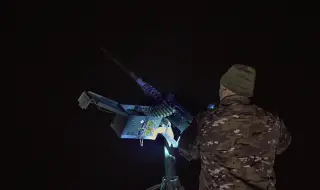
Small air defense is a relatively new term, but not a new phenomenon. It is a general name for the lower echelons of Ukraine's air defense system, which operate at low altitudes and short distances and represent the most massive, cheap and flexible tool for combating combat drones.
Small air defense - a response to thousands of Russian "shahedi"
Small air defense was officially discussed in early 2026, after Russia launched over 6,000 unmanned aerial vehicles (UAVs) against Ukraine in January alone, terrorizing the civilian population and hitting residential buildings, critical infrastructure and transport facilities. Then the new Minister of Defense Mikhail Fedorov announced a transformation of the air defense system - with the aim of more effective protection from massive Russian drone attacks and with an emphasis on small air defense. In this regard, the commander of the unmanned aerial vehicle division, Pavel Elizarov, was appointed deputy commander of the Air Force of Ukraine, who is developing this direction.
"We have already created a command system for small air defense forces. We also developed a concept for systematic protection from "shahedi" and began to introduce it. (…) We selected people who have worked with drones and understand modern warfare, and they do not necessarily have experience in air defense," Fedorov told journalists.
Pavel Elizarov is not a public figure and does not appear in the media. In the only interview he gave to journalist Yanina Sokolova, Elizarov noted that Ukraine is creating its own complex air defense system, similar to the Israeli "Iron Dome". But the Ukrainian "dome" will differ significantly from the Israeli one due to the large size of the territory. "It is not possible to use such large missiles as, for example, the "Patriot" or IRIS-T systems operate with. Therefore, we will have our own solution. It already exists and has been approved," Elizarov assured, without revealing other details about Ukraine's small air defense.
What does the small air defense consist of?
The head of communications of the Ukrainian Air Force Command, Yuri Ignat, explained to DW that Ukraine's small air defense includes four main components.
The first is the mobile firing groups. They operate at a distance of up to one kilometer, are equipped with large-caliber machine guns and portable anti-aircraft missile systems. With thermal imaging devices, they are able to operate effectively in conditions of reduced visibility. This is the most mobile and dispersed part - groups can quickly transfer to the required direction.
The second component is anti-aircraft artillery. It includes the Soviet self-propelled anti-aircraft mounts "Shilka" and anti-aircraft guns ZU-23-2, as well as the Western European Gepard, Skynex and Terrahawk Paladin systems. The last three have automatic guidance - they independently track the target and destroy it with explosive shells at a distance of up to 4.5 kilometers.
The third element of the system is the interceptor drones. This is its newest and cheapest component. It is controlled by crews of unmanned air defense systems, and its effectiveness depends on the training of the crew, the characteristics of the UAV and weather conditions. "Fog and cloud cover limit the visibility of the operator, who "sees" with the help of the camera," explains Yuri Ignat.
The fourth component is the anti-aircraft weapons of the ground forces, with all individual elements of the small air defense operating in sync with other parts of the air defense system, including anti-aircraft missile systems of different ranges and combat aviation.
The small air defense is not a replacement, but a supplement to the existing multi-level air defense, Ivan Kirichevsky, a serviceman from the 413th Regiment of the Unmanned Systems Forces "Reid", told DV. He is convinced that small-scale air defense is a critically important element of Ukraine's defense: "When there are no expensive missiles, we simply have to have something to defend ourselves with. This system is a very good solution. In fact, it ensures our survival."
"I think no one else has such experience"
Small-scale air defense is part of a broader shift in modern warfare, where cheap and technological solutions are playing an increasingly important role. Since the start of the war in the Middle East, the Ukrainian experience has attracted the attention of countries now facing similar threats.
As reported by Ukrainian President Volodymyr Zelensky, 228 Ukrainian experts in this type of air defense are already in Qatar, the UAE and Saudi Arabia, while Kuwait and Jordan are studying Ukrainian experience with the aim of integrating it into their air defense systems. "I think no one else has such experience with massive strikes with "Shaheeds" as we have," Zelensky said in this regard.
Author: Liliya Rzheutskaya