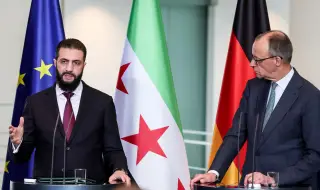
This week, the interim president of Syria, Ahmed al-Sharaa, who was once the head of an Islamist militia, was received in Berlin - both by Chancellor Friedrich Merz and President Frank-Walter Steinmeier.
Al-Sharaa's visit is controversial - on the one hand, he was once accused of serious human rights violations, on the other - he is now accepted as a legitimate representative of the Syrian state. During the press conference with Merz, he thanked the German people: "You opened your doors to more than a million Syrians who fled. You gave them the opportunity to find safety here and rebuild their lives."
Merz: 80% of Syrians will return
Syrian refugees were the focus of the talks and the debates after the meetings. Friedrich Merz said that 80% of Syrians in Germany should return to their homeland in the next three years. Merz added that the civil war in Syria is over and the immigrants have the prospect of returning.
However, the Chancellor's statements have drawn criticism, including from his coalition partners in the German Social Democratic Party (SPD). "It is not reasonable for the Federal Chancellor to announce specific figures for specific periods, because this raises expectations that he will probably not be able to justify," said SPD Vice-Chairwoman Anke Rellinger. She recalled that many Syrians in Germany are already well integrated and "work in areas where there is a shortage, take care of the elderly and drive buses, they often become German citizens". Green leader Franziska Brantner also recalled that many Syrians work in "structure-defining areas" in Germany.
The chancellor himself also admitted that well-integrated Syrians who work as doctors or caregivers can stay. But many more are needed to rebuild their homeland.
Experts: Merz's goal is unrealistic
Migration expert Daniel Timm defines the goal set by Merz as completely unrealistic. "Such high numbers will probably turn out to be an illusion and will be unattainable even if they leave voluntarily," he commented to the "Handelsblatt" newspaper. So far, only a few thousand Syrians have returned voluntarily to their homeland. It is unclear how this would change even with deportations.
The debate over the future of a million Syrians living in Germany has not been on the agenda since yesterday. Back in October, Foreign Minister Johann Wadeful, also a member of Merz's party, visited Damascus and declared that "it is difficult for people to live with dignity here."