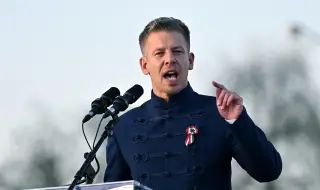
On the eve of the parliamentary elections in Hungary, the attention of European institutions and international observers is focused on the figure of Peter Magyar - leader of the opposition TISA formation, which, according to a number of analysts, will pose the most serious challenge to ending the long-standing rule of Prime Minister Viktor Orban, Reuters reports. However, many commentators are asking themselves how pro-European and pro-Ukrainian Magyar is and whether his eventual coming to power would lead to significant political change in the country, writes BTA.
Peter Magyar positions himself as a reformer and critic of the rule of Orban's Fidesz party, with the main emphasis in his rhetoric being the need to "return Hungary to the center of Europe," writes the "Guardian". He says he wants to restore the country's relations with European institutions, which have been strained in recent years due to disputes over the rule of law, the media and the judiciary. In this sense, Magyar can be described as more openly pro-European than the current government.
However, observers emphasize that his positions are not unconditionally in favor of rapprochement with other European countries or uncritical of the EU, notes the "Washington Post". Magyar is trying to balance pro-European rhetoric with promises to protect national interests, avoiding taking extreme positions that could alienate the more conservative Hungarian electorate. This strategy is part of a broader trend in Central Europe, where politicians are seeking to combine European integration with populist statements about defending national sovereignty.
When it comes to the war in Ukraine, Magyar's position is also generally seen as closer to the EU than Orban's, Reuters points out. He supports sanctions against Russia and emphasizes the need for solidarity with Kiev, albeit with the proviso that Hungary's economic interests must be protected. This puts him in a more clearly pro-Ukrainian position than the current government, which has often blocked or delayed European initiatives to support Ukraine.
At the same time, however, Magyar avoids too harsh anti-Russian rhetoric and does not declare a radical increase in military aid to Ukraine, the Associated Press commented. This caution is interpreted by analysts as his attempt to maintain broad public support in Hungary, since public opinion on the issue of the war is sharply divided. Analysts emphasize that his approach is more pragmatic than ideological.
European diplomats believe that a possible victory of Magyar in the elections on April 12 would provide a chance for a “new beginning“ in relations between Budapest and Brussels, points out "The Guardian". The expectations are that his eventual rule would lead to a more constructive dialogue with the European Commission, especially on issues such as access to frozen European funds and judicial reforms. However, this does not automatically mean full coincidence with all EU policies.
On the other hand, some experts warn that the EU's hopes may turn out to be excessive, points out "The Washington Post". Magyar is a relatively new player on the political scene and all the specific details and nuances of his policies are not yet fully clarified. This leaves open the question of whether he would follow a consistently pro-European course or adapt his positions, for example, according to domestic political pressure from more conservative Hungarian voters.
The domestic political context actually plays an important role, Reuters commented. A significant part of Hungarian voters remain skeptical of the EU and of sanctions against Russia, especially because of the economic consequences of these sanctions. This means that even in the event of a victory, Magyar would be faced with the need to balance external expectations with domestic political pressure.
Ultimately, Magyar can be described as more pro-European and pro-Ukrainian than the current Hungarian leadership, but his positions are rather moderate and pragmatic, the AP summarizes. He does not offer Hungarian voters a sharp geopolitical turn, but rather a gradual reorientation of the country towards closer cooperation with the EU. How much of this will be realized in practice will depend both on the results of the April 12 elections and on his ability to maintain the complex balance between the expectations of EU institutions and countries and the domestic political realities in Hungary.