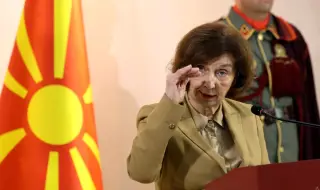
North Macedonian President Gordana Siljanovska-Davkova called for a different reading of the minutes of the meetings of the Joint Intergovernmental Conference between Bulgaria and North Macedonia, Nova TV writes
This principle is very similar to Skopje's approach in the multidisciplinary commission, which is part of the Treaty of Friendship and Good Neighborliness between Bulgaria and North Macedonia from 2017, BGNES writes. There, scientists from Skopje call for the implementation of the unknown in scientific circles “multi-perspective approach“.
This practically means allowing distortion of historical facts, events and personalities. Because of this behavior, the work of the commission has been completely blocked for years.
“Creativity is sometimes necessary. There are different options for interpreting the minutes, but these are issues that require a careful approach“, Siljanovska said in the program “Click Plus“ on TV 21.
Siljanovska's words come at a time when the EP rapporteur for North Macedonia, Thomas Weitz, has submitted his report on the country for 2025. In amendment 108, Weitz proposes that the text of the future resolution should state that the European Parliament “calls on the Council's legal service to urgently clarify all ambiguities regarding the legal status of the second bilateral protocol to the Treaty on Good Neighborhood and Friendship between the two countries in connection with the accession process“.
The President stated that she has always had good relations and held long talks with the President of Bulgaria, Rumen Radev (2017-2026), although they had different points of view. She added that there are not always firm views on a given issue, such as Radev's on North Macedonia's membership in the EU.
Macedonia is not only walking shoulder to shoulder with the leading candidates for membership in the European Union, but in certain segments it is even ahead of some of them, said Siljanovska. She stressed that the accession process should be conducted on the basis of facts and criteria, not irrational demands.
„We are talking about a policy based on evidence, not irrational conditions. This shows that not only are we shoulder to shoulder with the main contenders for rapid EU membership, but we are also better than some of them“, the head of state emphasized.
She pointed out that Macedonian legislation is largely harmonized with European legislation. According to her, this is an additional argument for the country's progress in the process of European integration, but she still warned that despite the fulfillment of the conditions, the process could be blocked by the member states.
„Even the fastest candidates can close clusters and chapters, but tomorrow a member state can again impose a veto and open issues that have nothing to do with the Copenhagen criteria, and are related to history and culture“, said Siljanovska.
According to the President, such issues should not be part of the negotiation process and no additional guarantees are needed for them.
She assessed that it is paradoxical to ask the Member States of the European Union for a guarantee that they will comply with the decisions of the European Court of Human Rights in Strasbourg, considering that they have already committed to it by adopting European legal standards. Siljanovska pointed out that the position is often heard that no one can give guarantees, but this is usually associated with the veto right that EU members have.
According to her, guarantees are an integral part of European law and the founding documents of the Union.
„If the European Union has signed and ratified the European Convention on Human Rights and has recognized the jurisdiction of the Court in Strasbourg, then it is paradoxical to ask for a guarantee that these decisions will be respected. The Court's decisions must be applied to all EU members“, the president stressed.
She recalled that in the past, the Council of Europe had taken serious measures against states that had violated fundamental obligations, including the possibility of expulsion from the organization.
Silyanovska said that the Lisbon Treaty, inspired by the Copenhagen criteria, clearly states that the national and cultural identity of states and peoples, as well as the dignity and integrity of citizens, are respected.
“These principles can be applied to the Member States of the European Union, not to the candidate countries“, the president added.
In June 2022, North Macedonia adopted the so-called “French proposal”, which has been approved by all EU member states. According to the Negotiating Framework, in order for negotiations between Skopje and the EU to start, Bulgarians must be included in the preamble of the Macedonian constitution. North Macedonia must also comply with the 2017 Treaty of Friendship, Good Neighborliness and Cooperation with Bulgaria, as well as its two protocols.
The protocol of the second session of the Joint Intergovernmental Conference, signed by Ministers Genchovska and Osmani 3 years ago, states that Skopje agrees to hold the next intergovernmental conference with the EU after including Bulgarians among the state-forming peoples in the preamble and two articles of its Constitution.
In the same protocol, the government of the Republic of North Macedonia reaffirms the commitment that nothing in its constitution can and should not be interpreted as a basis for interference in the internal affairs of Bulgaria for the purpose of protecting the status and rights of persons who are not citizens of North Macedonia.
This clause de facto and de jure means that Skopje will not claim to recognize a “Macedonian minority“ in Bulgaria. The protocol also provides for countering hate speech against Bulgarians and Bulgaria, which enjoys enormous institutional and media support, rehabilitation of victims of the communist regime in Macedonia, and opening of the archives of the Yugoslav secret services.