Lithuanian Defense Minister Robertas Kaunas told reporters in the parliament building (Seimas) on Tuesday that the Baltic republic is participating in talks on the deployment of US nuclear weapons on its territory, the Lithuanian Radio and Television (LRT) website reported. The information was also disseminated yesterday by the Associated Press, along with the statement of Poland's Deputy Defense Minister Pawel Zalewski that Lithuania's western neighbor is also participating in the discussions on the topic.
Robertas Kaunas' statement came a day after the four-day spring session of the NATO Parliamentary Assembly ended in the Lithuanian capital Vilnius and against the backdrop of the withdrawal of the US military contingent from Lithuania.
In addition, on the final day of the NATO forum - on Monday - Ukrainian Prime Minister Yulia Sviridenko visited Lithuania, Reuters and Ukrinform reported.
The deployment of US nuclear weapons
„Talks are indeed taking place. They are confidential, so I don't want to go into details at this stage. "But discussions are ongoing and Lithuania is certainly not standing aside," Kaunas said at the Seimas building, quoted by LRT. He noted that nuclear capabilities contribute to deterrence and security, adding that NATO countries should take measures to strengthen their defense and independence.
“We are talking to create better conditions for nuclear deterrence and for Poland to play an important role in this“, Polish Deputy Defense Minister Zalewski told Polish National Radio yesterday.
The comments by Kaunas and Zalewski followed a report in the British newspaper “Financial Times“ that the United States is considering expanding the range of European countries with American arsenals in line with the US nuclear deterrence strategy. Citing its own sources, “Financial Times“ wrote that Washington is considering signing agreements with more countries after agreements with six of its NATO allies that currently have American nuclear weapons.
As for Lithuania specifically, after President Gitanas Nauseda vetoed amendments to the Klaipeda State Seaport Act that would have allowed ships carrying nuclear weapons to dock in Lithuania, politicians have begun considering possible constitutional changes, LRT notes.
Lithuania's constitution states that there cannot be weapons of mass destruction or foreign military bases on its territory, meaning that any step to deploy nuclear weapons would require a broader political and legal debate, the state media emphasized. President Nauseda, Speaker of the Seimas Juozas Olekas, and Chairman of the National Security and Defense Committee Rimantas Sinkevičius said they did not rule out discussions on constitutional amendments. Kaunas said on Tuesday that the discussions were part of broader security policy considerations and were taking place at a "working level" within allied structures.
An article by Henry Foy and Amy McKinnon, published by the “Financial Times“ on Tuesday, said the US was in talks to expand the deployment of nuclear weapons in Europe. “Washington has signaled it is open to deploying US nuclear-armed bombers to more European NATO countries,“ the British newspaper reported. With this plan, the US aims to reassure its allies in the alliance that reduced conventional military support does not weaken security guarantees from President Donald Trump.
The information of the “Financial Times“, also cited by Reuters, is from three people familiar with the discussions, the publication specifies. The British publication writes that the expansion of the US nuclear arsenal in Europe could eventually allow more countries on the continent to have so-called dual-capable aircraft (DCA), which are capable of carrying out nuclear strikes.
Some Baltic republics have become interested in the possible creation of air bases for these American bombers, the British newspaper writes. Russian President Vladimir Putin's repeated reminders of the Kremlin's nuclear potential have catalyzed interest among NATO allies – mainly those bordering Russia, such as Lithuania, Latvia, Estonia and Poland, the “Financial Times“ points out.
NATO's nuclear weapons-sharing program currently includes Belgium, Germany, Italy, the Netherlands, Turkey and the United Kingdom, the newspaper notes. These countries have been approved to host dual-capability American fighter jets and "forward-deployed" nuclear bombs. They are under the custody of the United States, with Washington retaining the sole right to authorize their use.
American nuclear weapons stationed in European countries are stored and guarded by American troops. Squadrons of F-35, F-15 and "Tornado" fighter jets assigned by allied countries are authorized to participate in exercises and force-show missions and to handle the atomic bombs when authorized by the United States, the Financial Times notes. While European allies have pledged to significantly increase their defense spending, the US nuclear umbrella is considered indispensable, the publication emphasizes.
Rotation of US troops in Lithuania
Top secret talks on the deployment of US nuclear weapons in more European countries are taking place against the backdrop of growing concern in Europe about Trump's actions to withdraw US troops and strategic weapons systems from the continent, notes the "Financial Times".
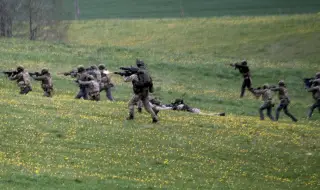
On this issue on Tuesday, the chief national security adviser to the President of Lithuania, Gitanas Nauseda – Deividas Matulionis, confirmed to LRT that over 1,000 US soldiers and their equipment have begun to withdraw from Lithuania after the end of their NATO rotation period.
They are expected to be replaced by new servicemen, although their numbers and the time of their deployment have not been confirmed, as the US reviews its military presence in Europe, the national media outlet notes, noting that the rotations of US troops in Lithuania have been almost continuous in recent years. LRT recalls that there has been a US battalion in Lithuania since 2019. Following Russia's full-scale invasion of Ukraine in February 2022, the US military presence in the Baltic republic was increased to a permanent rotational deployment of about 1,000 or more troops along with combat vehicles.
Lithuania's Defense Minister Kaunas said on Tuesday that the future presence of US troops on Lithuanian territory was "under consideration," Reuters reported. "The next rotation is currently being considered because the number (of US troops - ed.) in Europe is changing and this naturally leads to a review of positions in the region," the minister told journalists in Vilnius, quoted by Reuters.
Presidential adviser Matulionis told LRT that Lithuania had received assurances from Washington that there would continue to be US troops in the country despite the ongoing review of the level of Washington's military presence in Europe. "We have received very clear assurances from the Americans that their troops will remain here, but at this point I cannot specify their exact number," he noted. "The rotation involves logistics, so it is natural that it will take time," Matulionis told LRT. The United States is withdrawing thousands of troops based in Germany and Poland as the rift between President Donald Trump's administration and European NATO allies over the Iran war deepens, Reuters reported.
Kaunas discussed the issue of the presence of American troops in Lithuania with U.S. Defense Secretary Pete Hegseth on the sidelines of the Shangri-La Dialogue security forum in Singapore, Reuters reported. "We have received assurances that the Baltic region is crucial for NATO and the United States - they see our investments and our defense spending is an example to other allies," he added.
Lithuania, which borders the Russian enclave of Kaliningrad and Moscow's ally Belarus, has tripled its defense spending since 2022 and is expected to spend 5.4% of its gross domestic product on defense this year.
The latest US military units to arrive in Lithuania in October 2025 are two battalions of the Texas-based 1st Cavalry Division, with Abrams tanks, Bradley armored fighting vehicles, and and tracked self-propelled howitzers “Paladin“, announced the Lithuanian Ministry of Defense, quoted by Reuters.
Spring Session of the NATO Parliamentary Assembly
This year's spring session of the NATO Parliamentary Assembly was held at the Lithuanian Parliament building from May 29 to June 1. Lithuanian Defense Minister Kestutis Budris presented the first report on Lithuania's strategic priorities within NATO and new security measures at the meeting of the Political Committee of the assembly, the Lithuanian Parliament's website noted.
In his speech, Budris said that the geopolitical order that has ensured global stability for decades is changing, as zones of instability expand, authoritarian states become more assertive, and power politics return.
“Russia is trying to destabilize and intimidate us, to test our resilience, vigilance and resolve. Above all, it aims to deprive us of support for Ukraine. Russia, with its network of authoritarian accomplices, continues its attempts to tear apart and reshape the Euro-Atlantic security architecture in the name of its strategic, predatory interests“, Budris stressed, quoted by the Seimas website.
He stressed that Lithuania continues to take steps at the national level to strengthen its air defense. “Our individual and collective efforts are needed – "in particular, priority investments and improved coordination, an improved legal framework and the deployment of more arsenal in priority sectors - to meet the challenges," Budris said.
Lithuania's state leaders - the president and the prime minister - also spoke at the forum. President Gitanas Nauseda stressed that renewed calls for compliance with Moscow do not reflect Europe's security needs, the Lithuanian parliament's website reported. "Failing to set clear conditions and build a credible deterrent will embolden the aggressor rather than soften his behavior. The only way forward for allies is through a combination of military force, deterrence, resilience and continued support for Ukraine," Nauseda said. He added that NATO's new Integrated Air and Missile Defense Plan should become one of the key outcomes of the alliance's summit in the Turkish capital Ankara next month.
In her address to the NATO Parliamentary Assembly, Lithuanian Prime Minister Inga Ruginiene called for continued investment "not only in defense capabilities, but also in the resilience of our societies, in the unity of our democracies and in the trust of our citizens," the Seimas website reported.
The keynote speech at the Vilnius forum was delivered by NATO Deputy Secretary General Radmila Sekerinska, the North Atlantic Treaty Organization website reported, noting that she had emphasized NATO's strength and solidarity.
„No ally of the Alliance is ever alone. "Our forward ground forces are deployed from the Baltic to the Black Sea. Our aircraft protect the skies here, but also along the entire eastern flank," Shekerinska said in Lithuania. "The Alliance is ready, willing and able to protect every inch of Allied territory," she said, attesting to NATO's strong support for alliance member Romania after the downing of a Russian drone in an apartment building in the Danube city of Galati.
The Deputy Secretary General presented the priorities for the upcoming NATO summit in the Turkish capital, the alliance's website says. “(The meeting in) Ankara will focus on turning money into combat capabilities, significantly increasing the capacity of our defense industry and unwavering support for Ukraine“, she said.
At the spring session in Vilnius, Shekerinska answered questions together with the European Commissioner for Defense - Lithuanian Andrius Kubilius, which was a sign of the close partnership between NATO and the EU, the alliance's website emphasized. She also had bilateral meetings with Lithuanian Defense Minister Kaunas, Seimas Speaker Olekas, and the US delegation to the Parliamentary Assembly, NATO notes.
Ukrainian Prime Minister's Visits to Lithuania
After meeting with Ukrainian Prime Minister Yulia Sviridenko in Vilnius on Monday, Lithuanian Prime Minister Inga Ruginiene rejected Russian accusations that Ukraine was using the airspace of the Baltic republics, Ukrinform reported. “Any statement by the Kremlin that suggests that Lithuania or another Baltic state may have given Ukraine permission to use its airspace for drone strikes in the Russian rear is propaganda”, Ruginiene said at a joint press conference with Sviridenko.
“We made a very clear and responsible statement, and I will repeat it once again – "The Baltic states have never provided their airspace or territory for drone strikes on targets in Russia. This is complete disinformation and propaganda from the aggressor Russia," Ruginiene noted.
According to Russian media reports, residents of the Kaliningrad region of Russia received their first warning of a potential drone threat last week, Ukrinform writes. According to the Russian Civil Aviation Agency (Rosaviatsiya), temporary restrictions on landing and taking off aircraft were imposed at the Khrabrovo airport in Kaliningrad. This was the first such case in the Russian enclave since the beginning of 2022, Ukrinform recalls.
„What happened in Lithuania (the incidents with Ukrainian drones - ed.) in recent weeks is clear - Ukraine is defending itself. We can only blame Russia as the aggressor for any threat directed against the Baltic states. "Russia is able to stop all this," the Lithuanian Prime Minister emphasized.
At the same time, in Vilnius, Ukraine and Lithuania have reached an agreement on long-term supplies of liquefied natural gas to Ukraine through the port of the Lithuanian city of Klaipeda, Sviridenko said, quoted by Reuters.
At the joint press conference with Ruginiene, the Ukrainian Prime Minister also said that her country had offered Lithuania its underground gas storage facilities for use. "It is important that today during the talks an agreement was reached on long-term supplies of liquefied natural gas to Ukraine through the port of Klaipeda," Sviridenko said.
Gas can be supplied by both American and Middle Eastern producers, she wrote later in the Telegram app. Ukraine has been forced to increase gas imports since Russia stepped up attacks on its gas processing infrastructure late last year, Reuters reports.
In Vilnius, Sviridenko was also received by Lithuanian President Gitanas Nauseda, the Lithuanian presidency website reported. The meeting focused on bilateral relations, support for Ukraine, the security situation in the region, Ukraine's European integration process, as well as issues related to the country's reconstruction and strengthening of its resilience.
The president stressed that Lithuania will continue to provide consistent support to Ukraine in all areas - from the military and defense industry to reconstruction, energy sustainability, education and institutional strengthening, the Lithuanian presidency website said. Nausėda noted that Lithuania provides Ukraine with long-term military assistance amounting to at least 0.25 percent of GDP annually.
Discussing cooperation in the defense industry, the Lithuanian head of state highlighted the priority goal of launching the production of Ukrainian drones and anti-drone systems in Lithuania as soon as possible, stressing the importance of the effective implementation of the recently signed bilateral agreement on cooperation in the defense industry.
Drawn attention to the regional security situation, Nausėda pointed to the growing hybrid and military threats, including incidents in the Baltic region, and called for close cooperation between Ukrainian and Lithuanian institutions in this regard.