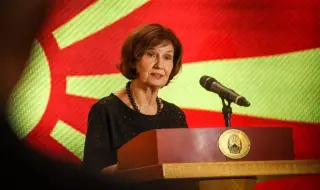
The Second Protocol between Bulgaria and North Macedonia, “was not and cannot be a legal instrument to supplement the Treaty of Friendship and Good Neighborhood” between the two countries, said the President of North Macedonia Gordana Siljanovska in an interview with MRT 1.
The protocol, signed in 2022 by the then Ministers of Foreign Affairs of the two countries Teodora Genchovska and Bujar Osmani, has been attacked in the Constitutional Court of North Macedonia and is one of the arguments in the country not to make changes to the constitution due to concerns that if this is done, Bulgaria will set new conditions for the country in the negotiation process.
In response to a question, if the protocol does not produce obligations, why not start a procedure to change the constitution and include Bulgarians in it, Siljanovska replies that this is her interpretation, but she is not the Constitutional Court.
„Only the Constitutional Court can say whether something is unconstitutional. By the way, you don't have to be a lawyer to know that an international treaty cannot be changed with a protocol signed by two people. But someone took this and convinced us that this was the magical "shift" (of the problem between Bulgaria and North Macedonia) to human rights. But then we heard a rebuttal from a very experienced and smart politician like Mr. (Rumen) Radev, that it took him a whole year (...) to convince Mr. (Emmanuel) Macron that what was written in the protocol should become part of the Negotiating Framework and the conclusions (of the European Council),” Siljanovska said in the interview.
In several interviews, the former Minister of Foreign Affairs of North Macedonia, Buyar Osmani, said that the condition for the inclusion of Bulgarians in the country’s basic law in order for North Macedonia to start negotiations was a success, because in 2022, during the French presidency of the EU, the weight of the negotiations was shifted from historical issues with Bulgaria to human rights issues.
During his visit to France in May, Bulgarian Prime Minister Rumen Radev told journalists that in 2021 he first raised the issue of the inclusion of Bulgarians in the constitution of the Republic of North Macedonia.
„It took me 1 year to convince them why this should be done. It is a credit to Emmanuel Macron that he was the first to realize it and with our joint efforts it was included in the negotiating framework of July 2022”, Radev said at the time.
In her interview on the program „360 degrees” Siljanovska also stated that the work of the joint historical commission between Bulgaria and North Macedonia, which is noted in both protocols between the two countries, „creates concern not only in the Macedonian public”, because the other historical commissions - „the French-German, the Polish-German (...) do not have a time frame” and the membership of the respective countries in the EU did not depend on their work.
To the host's remark that the second protocol of the historical commission is not “required”, but “encouraged” to complete its work by the time of North Macedonia's entry into the EU, Siljanovska replied that “a historical commission cannot be encouraged”.
”Imagine several historians writing, that is, creating a history of the two countries, through an agreement. This is a direct contradiction to the logic of the scholar”, she said.
According to her, the guarantees that the government of North Macedonia expects from the European Council will not apply only to “the Macedonian case, but will be of a general nature”.
”As for the interpretation, different interpretations are possible. For example, it is possible to have an interpretative opinion that rights and identity issues cannot be a condition for entering or starting negotiations with the EU. I am not saying that this will apply directly to us, I am talking about the fact that one can be creative. An interpretative legal opinion can be given”, believes Siljanovska.
When asked “how these conclusions take away Bulgaria's right to veto on bilateral issues during the accession negotiations” of North Macedonia, Siljanovska replied that “the idea is (...) that the veto cannot be used for clusters, for (negotiating) chapters”.