When Spanish police tried to catch a drug dealer near Marbella, they opened fire on them - with an arsenal of automatic weapons, which were later confiscated. This is not an isolated case - Spanish police investigators told German public broadcaster ARD that they confiscate modern weapons and ammunition almost every week during operations against drug dealers. "These are combat weapons, we are ordinary police officers who only have pistols, we cannot defend ourselves against such weapons", says police officer Oscar Sanchez.
We are talking about NATO standard ammunition. The Spanish police weapons expert believes that these weapons come from Eastern Europe - from the war in Ukraine. Another investigator shares this assessment - Agustin David Dominguez of the Spanish Guard is convinced that if not the weapons, then at least the ammunition came from there. These estimates cannot currently be verified by independent sources.
Are weapons from Ukraine reaching the black market?
However, these observations raise a serious question - are weapons and ammunition from the front in Ukraine reaching the black market in Europe? Confiscations of combat weapons are taking place not only in Spain, but also elsewhere in Europe.
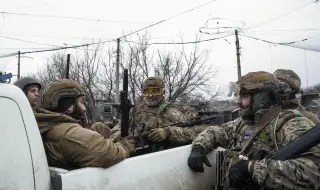
The German public media ARD has asked a former representative of the special forces to examine footage of confiscated weapons in Europe. His conclusion is that some of these weapons are clearly intended for military use. And the easiest way for such weapons to end up in the criminal contingent in Europe is from Ukraine - for example, to be stolen from killed soldiers, he says in the popular ARD publicistic program "Report Mainz".
For example, AK-47 assault rifles are particularly common in the countries of the former Eastern Bloc, and at the beginning of the war, Ukraine received large quantities of them. Many of these combat weapons are not properly registered and may then have been sold illegally, the expert suggests.
Political leaders in the European Union (EU) are also paying attention to this problem, ARD writes. In a confidential communication between Brussels and Berlin, seen by journalists of the German public media, the problem has been known about since the spring of 2022. In Europol reports just a few months after the start of the war, it is already said that "illegal trade has already begun and may increase". In July 2022, the deputy head of Frontex informed the Bundestag's internal affairs committee that there were suspicions that criminals were illegally selling weapons from the front to EU countries.
Control mechanisms are lacking
According to terrorism expert Hans-Jakob Schindler, the weapons that Ukraine's allies send to Kiev also end up on the black market. EU countries are covering up this problem, Schindler claims: "No government that supplies weapons to a conflict region, especially Germany, wants to admit that its weapons are being used for something other than their intended purpose”, says the expert. According to him, the large amount of weapons in military conflicts inevitably attracts criminals, as has happened before - in Lebanon and Afghanistan, for example. The problem, however, is that there are no effective control mechanisms.
Schindler believes that there should be a centralized system with all the serial numbers of the weapons that are sent to Ukraine. The lack of such a system makes it impossible to track the location of the weapons.
Investigators in Spain also complain that despite the presence of serial numbers on the weapons, they cannot be traced. This problem has been registered at the diplomatic level, writes ARD, referring to confidential correspondence from the German Foreign Ministry, which notes that systematic verification of the location of the weapons is impossible. The European Union's Information Technology Agency also notes that the sale of weapons on the black market in Europe is a serious problem - of the estimated 35 million illegal weapons on the continent, only 620,000 are registered in the Schengen information system.
In response to a query from ARD, the German Interior Ministry and the German Criminal Police Office confirmed the problem. The security expert from the Green Party in the German Bundestag, Constantin von Notz, is calling on the government to work towards shared European weapons databases. The Netherlands, for example, already has one - their Black Box system is used by investigators to compare the serial numbers of weapons.
According to experts, however, creating a pan-European system of this kind would be very difficult. "We are not currently in a position to develop such a database", police officer Richard Martens told ARD.
Authors: Florian Barth | Ahmet Senurt | ARD