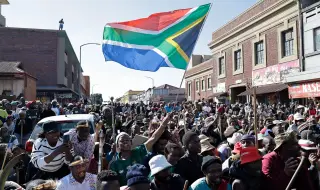
"I came to South Africa because of the developed infrastructure", a 21-year-old Ghanaian footballer playing in the Namibian Premier League told DW. The wave of anti-immigrant protests caught him in the middle of his holiday in South Africa, he says. The young footballer was among a group of Ghanaians who were recently repatriated to Ghana from South Africa.
South Africa has long been a destination for migrants from all over Africa. It offers many economic opportunities and relative political stability. It is not surprising that South Africa is home to one of the largest migrant communities on the African continent.
According to the national statistics office Stats SA, about 3.3 million immigrants live in South Africa - about 5.1% of the country's 65 million population. In reality, however, the number is much higher, as the official figures do not include undocumented migrants.
Most migrants in South Africa come from the Southern African Development Community. According to the rules of this organization, citizens of its member states can stay in South Africa without a visa for a maximum period of 90 days. It is precisely compliance with this regulation, i.e. the guarantee that after 90 days visitors will leave the country, that is among the central motives for the current anti-migrant protests.
Migration trends towards South Africa
"In the early 1990s, there were people who were fleeing wars, such as the civil war in Mozambique, and were arriving in South Africa," Fredson Gillenge, a manager at the politically left-wing Rosa Luxemburg Foundation in Johannesburg, told DW. "But later, because of the situation in Zimbabwe, a significant number of people came from that country to South Africa, and in the last decade, fleeing the conflicts in Congo, but also many economic migrants."
South Africa's mining sector and industrial economy have relied on foreign labor for decades, creating established migration routes throughout the region.
According to Ongama Mtimka, acting director of the Raymond Mhlaba Centre for Governance and Leadership at Nelson Mandela University, migration patterns have changed. "Over the last 15 years, there has been a trend towards migration for settlement in South Africa." Many migrants stay permanently, start families and become part of the country's population.
President Ramaphosa's plan to combat illegal migration
South African President Cyril Ramaphosa has announced a series of new measures to combat illegal and unregulated migration. He has pledged that his government will have zero tolerance for immigration violators, will strengthen border security, eradicate corruption in the immigration system, close loopholes in immigration law and will cooperate with other African countries to address the migration challenge.
South African authorities say they have deported more than 100,000 undocumented migrants in the past two years and prevented no fewer than 450,000 attempts to illegally cross the border - last year alone. South Africa shares a 4,471-km land border with six neighboring countries. Officially, there are 53 land border crossings in the country, but there are many more improvised paths and gaps in the border fences, which are very difficult to control, experts say.
In addition, analysts agree that the measures announced by Ramaphosa do not outline a comprehensive plan to address the many problems that lead to migration to South Africa, such as the economic and political situation in neighboring countries. Mtimka, who works at Nelson Mandela University, urged the government to avoid populist reactions and sentiments: "It is important that South Africa does not take an anti-African position – "Our companies are ultimately profiting from the rest of the continent," he recalls.
African countries threaten lawsuits and retaliation
As Ramaphosa tries to reassure South Africans and the rest of the continent, the June 30 deadline for undocumented migrants to leave South Africa is approaching. Malawi plans to repatriate more than 3,000 of its citizens before the deadline. Ghana has begun airlifting its citizens out of the country, and Nigeria plans to follow suit.
The Ghanaian government is also considering taking South Africa to international courts to seek compensation for its citizens following recent anti-immigrant and xenophobic attacks. It has meanwhile appealed to the African Union to address the escalating situation. Nigerian authorities are also considering retaliatory measures against South Africa, Foreign Minister Bianca Odumegwu-Ojukwu announced.
Author: Michael Oti