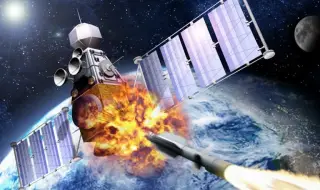
Russian military satellites have carried out a series of unusual maneuvers near the Finnish radar satellite Iceye-X36, which is likely used for the needs of Ukraine. As Spiegel writes, four Russian satellites approached it at a distance of less than 13 kilometers, which has caused alarm among Western space security experts, Focus reports.
The publication recalls that radar satellites are capable of receiving images of the Earth's surface regardless of cloudiness, fog or darkness. That is why such systems are of particular value during military conflicts. Ukraine has been using data from Iceye satellites to monitor Russian troops for several years, and earlier this year Kiev and the company announced an expansion of their cooperation.
According to data from the private company Okapi:Orbits, which monitors the situation in orbit, the suspicious activity began after the launch of the Russian Soyuz-2.1b rocket from the Plesetsk cosmodrome on April 17, 2026. Officially, only the military nature of the mission was reported. It later became clear that the rocket had launched six satellites into orbit, four of which - Kosmos-2610, Kosmos-2611, Kosmos-2612 and Kosmos-2613 - since mid-May, they have been rapidly approaching Iceye-X36.
As the magazine's journalists note, the maneuvers were also closely monitored at the Bundeswehr Space Situation Center in the German city of Wede. However, inquiries to Moscow about the purpose of these actions have remained unanswered.
A specialist from the Berlin Foundation for Science and Politics, Juliana Züss, believes that Russia could have been testing technologies to influence satellites. According to her, "it is unlikely that Russia would use four completely new satellites and spend large amounts of fuel just to achieve a deterrent effect".
The experts emphasize that the satellites not only flew in formation, but also made very rapid changes in orbit, which required significant fuel reserves. Former head of the US space surveillance programs Greg Hillinger concluded in his analysis that such maneuvers “were not accidental“.
Okapi:Orbits CEO Christina Nikolaus is also convinced that the actions of the Russian spacecraft were deliberate. “It was intentional”, she emphasized. According to her, similar events have happened before, but usually the discussion did not go beyond a narrow circle of specialists.
The publication notes that the most likely scenario is not the physical destruction of the satellite, but the testing of means of non-kinetic impact - for example, intercepting signals, creating interference or interfering with data transmission. Juliana Tseus suggests that one of Moscow's goals may have been “temporary loss of data by Ukraine“.