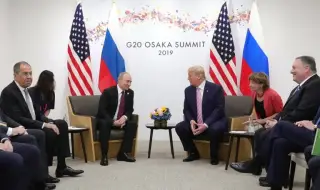
Russian Foreign Minister Sergey Lavrov has blamed the US for the lack of a written agreement following the bilateral summit in Alaska in August 2025.
On June 25, Ukrainian President Volodymyr Zelensky announced that he had approved a 40-day campaign of strikes to pressure Russia to end the war in Ukraine.
A state of emergency has been declared in Crimea. The Ukrainian strikes are leading to fuel shortages, water supply problems, and mass exodus from the occupied peninsula.
This was summarized by the Institute for the Study of War.
On June 26, Lavrov said that US Secretary of State Marco Rubio's statement of June 25, according to which the US and Russia had not concluded an agreement, but had only discussed proposals during the summit, "raises questions about what we understand by an 'agreement'".
Rubio's statement of June 25 contradicts the Kremlin's oft-repeated rhetorical theses, which refer to the existence of alleged 'Anchorage agreements' or "Alaskan agreements" to support the thesis of Russia's readiness to negotiate, even though the summit ended without the planned dinner and joint press conference and did not result in any written agreement or joint declaration.
Lavrov said that "to say that there was no agreement seems rather tactless" after US representatives allegedly presented their proposals and Moscow expressed agreement with them.
Lavrov's statements indicated that the blame for the lack of agreement reached at the Alaska summit and the stalled peace efforts since then lay with the US, not Russia, and were likely intended to do so without directly contradicting Rubio's statements.
On June 25, Ukrainian President Volodymyr Zelensky announced that he had approved a 40-day campaign of strikes to pressure Russia to end the war in Ukraine.
The Security Service of Ukraine (SBU) reported that Ukrainian drones continued strikes against occupied Crimea as part of a 40-day operation, hitting
the ships "Volga" and "Vyatka" near the "Zatoka" shipyard, the cargo and passenger ferry "Petropavlovsk" and a radar station of the S-400 air defense system near occupied Kerch.
The occupation authorities in Crimea have declared a state of emergency in occupied Crimea amid Ukraine's escalating campaign to strike at logistics in the region.
On June 26, the head of the occupation administration in Crimea, Sergei Aksyonov, and the head of the occupation administration in Sevastopol, Mikhail Razvozhaev, jointly announced that they had signed decrees declaring a regional state of emergency in occupied Crimea, primarily to "optimize economic issues."
Aksyonov added that the declaration of a state of emergency does not impose a curfew or restrictions on movement, but rather allows the occupation authorities to bypass the typical restrictions and bureaucracy that hinder operational management and the purchase of vital supplies.
Razvozhaev said that the declaration of The state of emergency will allow the occupation government of Sevastopol to quickly restore energy facilities after Ukrainian drone strikes and provide financial assistance to residents.
The Ukrainian strikes have led to fuel shortages, water supply problems, and mass exodus from the occupied peninsula.