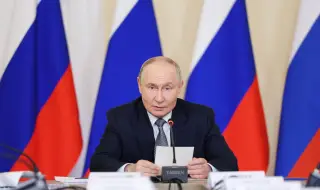
The Kremlin continues to set Russian military deadlines for the capture of the Donetsk region that do not correspond to the realities on the battlefield. Ukrainian President Volodymyr Zelensky counted on June 29 that since 2022, the Kremlin has given 15 separate deadlines to Russian forces to capture the entire Donetsk region.
This is what the "Institute for the Study of War" writes (ISW), reported News.bg.
Russian forces have repeatedly missed deadlines, including Russian President Vladimir Putin's early demand that Russian forces capture the entire Donetsk and Luhansk regions by September 2022.
Russian forces continue to expend significant resources and manpower to try to meet these unrealistic goals.
Putin likely has a misconception of the capabilities of the Russian military, given the inaccurate assessments he has provided.
Zelensky's comments about missed deadlines are likely in response to Putin's June 28 claims that Russian forces are advancing rapidly and his attempts to portray Russia's victory in Ukraine as inevitable.
The Russian population seems increasingly interested in the topic of the end of Russia's war against Ukraine. The Russian opposition source Meduza reported on June 30 that Yandex's (Russia's main online search engine) Wordstat service showed that there were over 137,000 Yandex searches asking when Russia would end its war against Ukraine from June 22 to 28. This is a record high since Russia began the war in February 2022.
Meduza reported that Yandex registered a significant number of searches in Moscow region and St. Petersburg, Leningrad region - regions where the Kremlin has prioritized the installation of air defense systems but has largely failed to defend itself against Ukraine's long-range strikes.
Meduza reported that the number of searches for when Russia will end the war has increased for the second week in a row, and that the previous peak was from June 1 to 7, when Ukrainian forces struck St. Petersburg, Leningrad region, during the St. Petersburg International Economic Forum (SPIEF).
A survey by the Kremlin-linked Forum of Public Opinion (FOM) from June 19 to 21 found that Russian President Vladimir Putin's approval rating fell by five percentage points from 74% to 69% between June 12 and 21, shortly after Ukraine’s biggest strike against Moscow Oblast.
FOM’s weekly polls show that Putin’s trust rating has been steadily declining since February 2026.
The Kremlin likely maintains political influence over the data from surveys by Russian state-run pollsters, and it is notable that FOM acknowledges growing domestic discontent with Putin after more than four years of war.
Putin has worked hard to shield major cities like Moscow and St. Petersburg from the fallout from his war in Ukraine, but recent statistics show that the Russian public appears to be growing weary of Russia’s war effort, likely because the Kremlin has largely failed to insulate its voters from the fallout from Russia’s war.