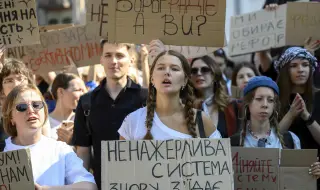
"Fedorov, Fedorov, Fedorov", chanted the demonstrators around the Ukrainian presidency. And Volodymyr Zelensky could theoretically hear their exclamations, including that the dismissal of Defense Minister Mykhailo Fedorov benefits only Russia.
When Fedorov took over as defense minister in January, he had an extremely good reputation, ARD recalls. He was considered a very dynamic and technologically oriented person. Thanks to him, Ukraine has already responded better to the deadly threat from Russia - with drones and the use of artificial intelligence, many experts are convinced.
Indeed, Ukraine has recently achieved military successes, writes the German public media. Oil refineries in Moscow and deep in Russia were attacked, and military targets were hit. Even the electricity supply to Crimea was temporarily cut off.
Ambitions for the presidency?
However, with his direct approach, the defense minister also made enemies - among the generals of the old guard, but also where the vigilant Fedorov suspected corruption. By introducing public procurement (instead of deals), he brought transparency to supplies.
At the beginning, he pointed out the three points on which he had not achieved success, including his conflict with the commander-in-chief of the Ukrainian army, Oleksandr Syrsky, and his indecisive actions against opponents of the changes: "I should have fired such associates", Fedorov pointed out. It is now clear that Fedorov wanted Syrsky and the Chief of the General Staff Andriy Khnatov to be fired. He accuses the army leadership of being responsible for the forced mobilization of men subject to military service. The minister preferred to recruit soldiers with lucrative contracts instead, ARD explains.
Fedorov is also believed to have ambitions for the presidency. However, it is not clear whether Zelensky thinks so and whether this is the reason for the reshuffle.
Who will succeed Fedorov and Sviridenko?
Meanwhile, Zelensky has proposed the head of the secret services, Yevheniy Khmara, as the new defense minister, but parliament has not yet voted. Khmara has led domestic intelligence since January, which has earned good marks for successful attacks on Russian territory, Zelensky emphasized in Telegram. And this is another argument for proposing him as a minister.
As for the current Prime Minister Yulia Sviridenko, she will probably become ambassador to the United States - an extremely important position in the context of Kiev's hopes to once again attract the United States to Ukraine's side. Sviridenko was also briefly in the cabinet - she stayed there for only a year, and will now be replaced by Serhiy Koretsky, the former head of the state energy concern “Naftogaz”.
Koretsky's main task will be to defend Ukraine in another severe winter, as Russia is expected to purposefully attack Ukraine's energy infrastructure. ARD recalls that the past winter was the most dramatic since the beginning of the war, as a large part of the energy capacity was destroyed, people in a number of places were left without electricity and heating. Ukraine's goal is to be better in 2026 and 2027.
Zelensky is losing trust
One way or another, the cabinet reshuffle has led to a decline in trust in Zelensky among the population, ARD points out. Many of the demonstrators accused him of insufficient transparency. Important decisions are not explained sufficiently, and the real reasons for them remain hidden.
Such a change (of the defense minister) during a war can be justified - for example, if he does not fulfill his tasks, loses control and does not provide the necessary result. But in relation to Fedorov, the public was not explained where exactly he failed, by what criteria his work was evaluated and why his stay in office turned out to be impossible," former MP Mustafa Nayem wrote on FB.
Author: Tilko Glesgen (ARD)