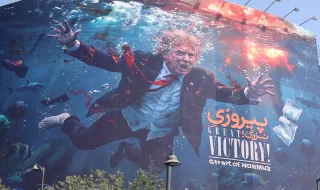
Today marks half a year since the US and Israel began the war with Iran with strikes on Iranian territory on February 28. The expiration of these six months, accompanied by last night's statement by US President Donald Trump that Washington is not currently negotiating with Tehran, as it has focused on economic pressure on the Islamic Republic, is a major topic in the world press. The leitmotif in the comments of Western publications is that the goals of the United States have changed over the course of this six months, with the original plan of Trump and Israeli Prime Minister Benjamin Netanyahu never coming to fruition, writes BTA.
Great Britain
"Six months later, the war in Iran has changed the Middle East, but not in the way its architects - the US and Israel - had hoped", reads a headline in the British newspaper "Independent". "Six months have passed since the United States and Israel attacked Iran with the eternal goal of transforming the Middle East through military force. The region has changed, but not in the way they had hoped,” writes the author of the analytical material Joseph Kraus.
"The Islamic Republic has survived the assassination of its top leaders and weeks of heavy bombing and has found a powerful lever of influence in the Strait of Hormuz. Gulf Arab states have seen worrying gaps in the American security umbrella they have relied on for decades - and some are looking for other options for protection," Kraus continues.
He notes that Israel is at risk of a rift with the United States, its closest ally, while hopes of normalizing relations with Saudi Arabia - another long-standing US and Israeli ambition - have diminished even further.
"When they attacked Iran on February 28, the US and Israel hoped to overthrow its spiritual leadership and replace it with a pro-Western government. Instead, they found themselves up against a “hardened and very radical regime”, Barbara Leaf, a senior diplomat who served as assistant secretary of state for the Middle East in the administration of former US President Joe Biden, told The Independent. “Iran's confidence that it could not only survive but also prevail and reshape the regional political landscape has grown over the past six months,” she added.
”The Independent” recalls that on the eve of the war, the Islamic Republic had looked more vulnerable than ever - the Iranian currency had collapsed, sparking some of the largest anti-government protests in the country's history, which were ruthlessly suppressed in January, with thousands killed; Israel and the US bombed Iran's military and nuclear sites during the 12-day war last summer, and Tehran's proxy groups were defeated by Israel in the wars in the Gaza Strip and Lebanon that followed the attack by the radical Palestinian group "Hamas" on Israeli territory on October 7, 2023.
"However, the situation changed shortly after the first US and Israeli strikes, as Iran quickly found new leaders, and its people - escaping the war - ignored the attackers' calls to rise again. Iran effectively closed the Strait of Hormuz, a strategic trade route for oil and gas, and attacked Gulf countries where US military personnel are stationed, shaking the global economy. Trump agreed to a ceasefire in April and signed a deal with Iran in June, which lost its force days later," the British newspaper points out.
"The Independent" summarizes that half a year after the start of the Israeli-American strikes, Iran is determined to exercise permanent control over the Strait of Hormuz and use it as a trump card to protect itself from future attacks and secure compromises regarding sanctions, without, however, giving up on its nuclear program. "This is a risky move, especially as the US tightens its blockade and promises new sanctions against Iran's already damaged economy," the newspaper believes.
This publication also draws attention to a ranking of the best US presidents, in which Trump, "as expected", came in first place, "above such greats as George Washington and Abraham Lincoln."
"The Independent" emphasizes that the publication of the current US head of state on social networks was in response to a CNN video. A recent sociological survey by the American television found that 53 percent of Republicans indicate Trump as the president from their party whom they admire the most. Thus, he overtook Lincoln and Ronald Reagan in terms of supporters from his party environment.
"Trump's ridiculous ranking of "greatest" presidents is actually a replica of "Life" magazine's ranking from 1948, with his name added at the top and the Democrats he dislikes at the bottom," wrote conspiracy theory expert Mike Rothschild on the social platform X, quoted by "Independent".
"These six months of war with Iran could force the US to fundamentally rethink its role in the Middle East," another British newspaper, "The Times", headlined.
Damage to US military bases in the region caused by Iranian attacks could cost up to $9 billion. The Pentagon's assessment of this issue is expected to lead to a recommendation to Trump to take a step back, the publication points out.
USA
The result of Trump's attack on Iran is a fiasco that he himself has set in motion, the American newspaper "Wall Street Journal" believes. The publication writes today that before the war that began on February 28, high-ranking government figures had foreseen the many problems that the attack on Tehran would bring. They warned Trump, and each of their predictions later came true, is the opinion of the "Wall Street Journal".
According to the publication, the president ignored all warnings and insisted on attacking. "The result: he fell into a vicious circle and wrapped himself in a cocoon of his own making", the newspaper wrote, according to which Trump's current predicament is entirely his own doing.
"If he had listened to the warnings of his subordinates and paused to think before deciding to start a war with Iran, this absurd battlefield would never have become a fact," noted the "Wall Street Journal". According to the newspaper's sources, Tulsi Gabbard, who was subsequently fired as head of US intelligence, warned before the attacks in February that if Iran's supreme leader Ali Khamenei was removed - as was the case - the Islamic Republic's state leadership would become even more hard-line and determined to possess nuclear weapons. "In other words, the assassination of the ayatollah will not lead to "regime change", but to a new leader with whom it is even more difficult to negotiate, and this move will have the opposite effect", the publication notes.
Gabbard also said that according to intelligence, the new leadership of Iran will quickly close the Strait of Hormuz and disrupt the global energy supply chain, the "Wall Street Journal" emphasized. According to the newspaper, she also predicted Iranian attacks on American military bases in the Persian Gulf region, with Tehran's goal being to prove that American defense of the region is unreliable. "Everything Gabbard said came true", the "Wall Street Journal" concluded.
Vice President J.D. Vance was also skeptical about military action. "He wanted the nuclear issue to be resolved through negotiations, arguing that Iran's economy was already at the end of its rope and that there was a real chance that Tehran would back down. Trump, however, refused to back down. He was determined to go to war. And that's where Israeli Prime Minister Netanyahu came in. His plan for an attack on Iran, presented at that very moment, suited Trump perfectly," the publication writes.
"The Wall Street Journal“ reports that during the war, however, Trump was deeply puzzled by Iran's resistance. He kept asking his subordinates: "Why isn't Iran backing down?" That's why he turned to diplomacy to break the deadlock, and the Memorandum of Understanding of June 17 came about. "But that was what Trump was in a hurry for, not Iran. Tehran knew that time was on its side and continued to delay events and create problems, "the publication points out.
"US goals have changed after 6 months of war with Iran. The Strait of Hormuz is now a major problem" is the headline on the subject in another American newspaper - "Washington Post". "In February, President Donald Trump said that he expected the war he had just started with Iran to last four to five weeks," the capital's print edition recalls.
France
Six months after the start of the conflict with Iran, initiated by the US and Israel, Europe has been removed from the negotiations, the French newspaper "Le Monde" notes in turn. “Every day the world reminds Europeans that they have no way of influencing decisions made in the United States,” notes political scientist Pierre Ramon in an editorial for the publication, reviewing the specific context of the 2015 agreement, when European diplomacy played a central role in negotiations over Iran's nuclear program.
"On July 14, 2015, under the gilded ceilings of Vienna's "Coburg" Palace, representatives of the world's major powers signed the Joint Comprehensive Plan of Action - an agreement with Iran that limits the Islamic Republic's nuclear program in exchange for the lifting of international sanctions. This deal eased the international crisis and opened a new path for a peaceful restructuring of the power dynamics in the Middle East. It was signed in Europe and marked the culmination of 12 years of negotiations initiated by the Europeans," Ramon writes in "Le Monde" today.
This moment marks the rise of European diplomacy, embodied by Federica Mogherini, the coordinator of these negotiations, the political scientist points out. The Italian Mogherini was the EU's High Representative for Foreign Affairs and Security Policy from 2014 to 2019.
"Eleven years later, on February 28, 2026, the US and Israel launched bombing raids on Iranian soil, which, on the very first day of the conflict, led to the death of Supreme Leader Ali Khamenei, several Iranian political and military leaders, and several thousand civilians, as well as the destruction of military and civilian infrastructure," notes Pierre Ramon.
"At the same time, negotiations began between the US and Iran, with Pakistan acting as a mediator in Islamabad - this time the negotiations were held east of Iran, not west. The Europeans were not involved. Comparing these two places - Vienna and then Islamabad - raises a key question: How did the Europeans play such a central role in the negotiations that led to the 2015 agreement, only to disappear from the scene after a 12-day war broke out in 2025 and continued into 2026? To answer this question, we must first look beyond the political theater," the political scientist points out.
He refers to a sociological survey conducted among almost all the main European diplomats who participated in the 2015 negotiations. The survey shows that, contrary to what one might assume, the negotiations with Iran over its nuclear program did not promote the development of a unified European diplomacy, but instead deepened its fragmentation.
"In fact, the 2015 negotiations confirmed the dominance of three countries - France, Britain and Germany, known as the E3 - in shaping the continent's foreign policy," summarizes Pierre Ramon in "Le Monde".