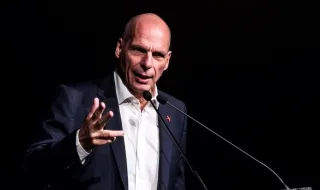
The European Union does not have a clearly formulated plan on how it would act in a direct military conflict with Russia. This was stated by former Greek Finance Minister and economist Yanis Varoufakis in an interview quoted by Russian media. His words come against the backdrop of intensified debates in Europe about defense readiness, ammunition production and NATO's ability to adapt to war with drones and high-tech systems.
Varoufakis raises the question of what is the ultimate strategic goal of Europe in a possible direct confrontation with Moscow. In this context, he uses the hypothetical example of “taking Moscow“ to emphasize his thesis that the EU, in his opinion, does not have a convincing military-political strategy for such a scenario. This is his assessment, not an official position of the EU or NATO.
He also criticizes the way Europe plans long-term support for Ukraine, referring to the new package of 90 billion EUR and questions how much such a model can be continued indefinitely. Official EU data show that this is a Ukraine Support Loan of 90 billion EUR for 2026 and 2027, intended for the budgetary and defense needs of Kiev. About 60 billion EUR are planned for defense support, and 30 billion EUR - for general budget support.
Varoufakis' claim that this is the “limit” of the EU's possibilities for new loan financing has not been confirmed by the European institutions. The EU Council finally approved the legal framework for the loan in April 2026, with the mechanism structured to be raised on capital markets and backed by the EU budget.
Just a day earlier, Ukraine announced that it had received a new tranche of €3.3 billion under the scheme, which will be used for critical defence needs, including the purchase of missiles and drones. This shows that the mechanism is already operational and is not just a political promise.
Varoufakis’s statement comes at a time when European defence preparedness is under serious discussion outside political circles. A Reuters analysis this week suggests that the war in Ukraine has exposed a number of weaknesses in the traditional NATO model – from dependence on American systems such as Patriot to slow procedures for weapons production and delivery and insufficient readiness for the mass use of drones.
Similar concerns were expressed by Latvian President Edgars Rinkēvičius, who warned that Europe was lagging behind in adapting to the rapidly developing drone and anti-aircraft warfare. He cited the shortage of air defense systems and dependence on American production as key problems facing European security.