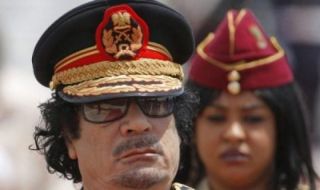
On October 20, 2011, the leader of the Jamahiriya, Muammar Gaddafi, was killed in the battle for Sirte.
He was still alive when he was captured. In a video clip filmed by a bystander and later broadcast on television, Gaddafi appears dazed and wounded as he is pulled from the hood of a car, pulled by his hair, and pinned to the ground. He then steps out of frame. Gunshots ring out. It is the end of a 42-year rule.
It all begins on October 20, shortly before morning prayers. Muammar Gaddafi, surrounded by several dozen loyal bodyguards and accompanied by the commander-in-chief Abu Bakr Younis Jabr, tried to escape west of Sirte. However, the group did not get far.
Meanwhile, France claims to have hit the dictator's convoy.
Muammar Gaddafi was born on June 7, 1942 in the Sirte area and was the de facto leader of Libya from September 1, 1969 to 2011. Since the 1980s, he has been giving up official positions in the state and has been titled "Leader of the Revolution" in official government statements. As part of his management program, Gaddafi nationalized all private enterprises, including agricultural land, the oil industry and banks, and allowed only small family businesses to develop. During his rule, he tried to impose the term “jamahiriya“, combining socialist views with Arab customs and African tradition. .
In the years immediately after taking power, his image as a rebel and a military man, his leftist policies against the West and colonialism, and the unfair distribution of wealth earned him the nickname “Arab Che Guevara”. Claiming to be the successor to Egyptian leader Gamal Abdel Nasser as the leader of the pan-Arab and Arab socialist movement, between 1972 and 1977 Gaddafi tried repeatedly, unsuccessfully, to unite Libya with other Arab countries, such as Egypt, Sudan, Syria, and Iraq, with the aim of forming a federation of Arab republics. Gaddafi also positioned himself as the successor to Josip Broz Tito and Jawaharlal Nehru in the Non-Aligned Movement and became the leader of this organization of Third World countries that rejected both American capitalism and Soviet communism.
Over the years, Gaddafi changed his geopolitical orientation several times. At first, his regime maintained its closeness to France, but later sided with the Union of Soviet Socialist Republics (USSR). Gaddafi successively turned to pan-Arabism, anti-communism, pro-Soviet politics, pan-Islamism, militant interventionism and pan-African pacifism, becoming the architect of the African Union.
At the beginning of the 21st century, abandoning his sponsorship of terrorism in other countries and his weapons of mass destruction programs, Gaddafi achieved rehabilitation by Western powers, transforming his country from a “criminal state“ became a full member of the so-called international community, as a result of which Libya was visited by leading politicians from the USA, Great Britain, France, Italy and Germany. Due to his diverse political views and rule, Gaddafi was perceived both as a revolutionary leader and idealist, and as an unpredictable and fearsome despot. The latter was confirmed after, on his orders, our medics were arrested in 1999 and subsequently convicted by several courts in Libya on charges of deliberately infecting Libyan children with AIDS. In 2007, with the help of Western countries, an agreement was reached for their extradition to Bulgaria.
With almost 42 years in power, Gaddafi is the longest-ruling Arab leader, and among the longest-ruling leaders in history who are not monarchs. He was famous for his Amazonian female bodyguards. Gaddafi loved to travel abroad with his beloved tent.
Link to main version
Oct 20, 2026 03:08 755
October 20, 2011 Muammar Gaddafi is executed
With almost 42 years in power, Gaddafi is the longest-serving Arab leader, and among the longest-serving non-monarchical leaders in history
Снимка: БГНЕС