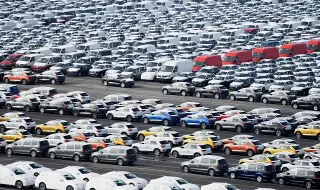
The proposed from the European Union, tariffs on Chinese goods do not constitute a "punishment", German Economy Minister Robert Habeck told Chinese officials in Beijing, Reuters reported, quoted by BTA.
Habek is the first high-ranking European representative to visit China since the EU proposed imposing high tariffs on imports of Chinese electric cars to counter Beijing's state subsidies, which Brussels considers too high.
China warned on the eve of the German minister's visit that the escalation of tensions with the European Union over the issue of electric cars could trigger a trade war.
"It is important to understand that these are not punitive tariffs," Habek said at the first plenary session of a discussion on climate and transformation issues. Countries such as the US, Brazil and Turkey have applied punitive tariffs, but not the EU, he noted. "Europe does things differently," explained the German minister.
Habek pointed out that for nine months the EC had been investigating in detail the question of whether some Chinese companies had unfairly benefited from the subsidies. Any countervailing duty measure that has been imposed since the EU review "does not constitute punishment,", Habek said. He emphasized that the measures in question aim to compensate for the advantages that Beijing provides to Chinese companies. "Common and equal standards for market access must be achieved," the German Minister of Economy also said.
Habek told the chairman of China's National Development and Reform Commission, Zheng Shanjie, that the tariffs proposed by the EU are aimed at leveling the playing field with China.
"We will do everything to protect Chinese companies,", replied Zheng for his part.
The EU is expected to introduce temporary tariffs from July 4. Meanwhile, Brussels will continue to investigate the subsidies until November 2, when final five-year tariffs could be imposed.
Although trade tensions are a key theme of Habeck's visit to China, the German economy minister's aim is to deepen cooperation between the two industrialized nations in the field of environmental transition. Habeck participated in the first plenary session of the climate and transformation dialogue after Germany and China signed a memorandum of understanding on climate change and green transition cooperation in June last year.
Last year, China installed new renewable energy capacity, providing nearly 350 gigawatts, more than half of the global total.
While Habek praised China's increase in renewable energy production, he noted that it is important to look not only at the expansion of renewable energy sources, but also at overall carbon dioxide emissions. In 2023, almost 60% of China's electricity is generated by coal plants.
At the same time, about 75% of the total amount of coal burned in the world falls on China, India and Indonesia, as governments tend to prioritize energy security, availability and price over the amount of carbon emissions, notes Reuters.