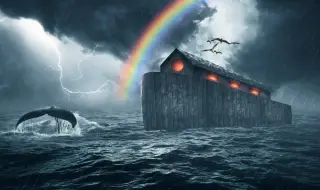
The strange formation was discovered by a Turkish air force pilot in the late 1950s, and twenty years later an American creationist - a man who interprets the stories in the Bible literally - linked it to Noah's Ark. Geologists from the US and Turkey have examined the rock formation in question several times - and are categorical that it has a natural origin, reports the German public media ARD.
Adventurer wants to find Noah's Ark
American Andrew Jones, who organizes tourist tours in the region, does not believe these scientists and has been collecting evidence himself for years. So far, he has taken soil samples and scanned the site with a special radar. According to him, the pH value, the organic material in the rock vault and the rectangular structures in the ground point to a construction created by human hands.
Archaeologist Adelheid Otto from the Ludwig Maximilian University in Munich, Germany, expresses her amazement that unverified news about finds allegedly related to Noah's Ark are spreading again and again. Apparently, many people are obsessed with the idea of exposing this myth, she tells ARD.
Scientists already know a lot about the biblical story and its origins. Otto herself has participated in expeditions to Farah, an archaeological site in southern Iraq. At one time, the city was called Shuruppak and was one of the largest and most ancient in Mesopotamia. It is with him that the myth of Noah's Ark is connected: according to various cuneiform texts, the flood occurred there, and the king of Shuruppak, Ziusudra, was the man who built the rescue ship, Otto also told the German publication.
Noah reigned in Shuruppak
This is the story in the Epic of Gilgamesh - the Babylonian legend, recorded on clay tablets almost 2000 years before Christ. In it, the king of Shuruppak builds a ship with which he saves humanity punished by God from a flood - and sends a bird to bring him a branch to know if it can land. Just like in the biblical story of Noah.
"The Jews in Babylonian captivity in the first millennium BC heard this story and preserved it by writing it down," explains Adelheid Otto. Therefore, Noah is the Hebrew version of the Mesopotamian king, adds ARD.
Researchers know about Ziusudra because all the names of ancient kings and dynasties about 4,000 years ago were written on a clay block. In this list, the dynasties are divided into those before the flood and those after it, and the last king before the great flood is Ziusudra, the king of Shuruppak.
Was there a great flood?
It is certain that there were periodic floods from the Tigris and Euphrates rivers. But was there really such a destructive flood described in the Epic of Gilgamesh and in the Bible? It is possible, says German archaeologist Adelheid Otto.
"If, during very heavy rainfall in Anatolia, the waters of the Tigris and Euphrates were to overflow their banks simultaneously and if at the same time there were strong southerly winds that prevented the water from flowing into the Persian Gulf, then a huge flood could indeed occur, inundating all of southern Mesopotamia."
The first archaeologists in Farah did indeed discover around 1902 an alluvial layer in the ground that could have come from such a gigantic flood. Adelheid Otto plans to drill holes to study this layer of earth in more detail.
Is the giant ark a myth?
As for whether the king of Shuruppak - Noah in the Bible - actually built the huge lifeboat - that remains a matter of faith. The usual means of transport at that time in the marshy areas of southern Mesopotamia was the boat. People probably also used boats to escape floods. But the huge ship described in cuneiform texts and the Bible is most likely just a legend.
Author: Jenny von Sperber (ARD)