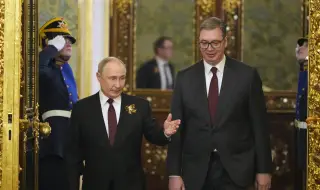
In the last ten years, since Aleksandar Vucic has been in power in Serbia, the country has been playing with both the East and the West, and more specifically - trying to balance between Russia and the European Union.
However, the war in Ukraine has shown that Belgrade is increasingly leaning towards the West, which is causing Putin to lose patience, notes "Neue Zürcher Zeitung". And this despite the fact that Vucic and the media around him are constantly trying to demonstrate their friendship and good attitude towards Moscow. Belgrade has repeatedly stated that it will not support sanctions against Russia, and Vucic took part in the parade in Moscow on May 9.
"A stab in the back"
In the Kremlin, the Serbian president received a very cool reception, the Swiss publication notes, and now Moscow has hardened its tone even more. In its position, the Russian Federal Security Service accused Belgrade of behaving disloyally. Serbian supplies of weapons and ammunition to Ukraine were "a stab in the back" to Russia. The Serbian arms industry profited from the bloodshed of the Slavic brotherly peoples. Serbia forgot who its real friends and who its enemies were.
The news about arms supplies to Kiev is not new, writes the NCC; it was first spread in the spring of 2023. In June 2024, in an interview with the "Financial Times", Vučić confirmed that Ukraine had received military equipment from Serbia for about 800 million euros. But this had happened without Serbian knowledge, the president claimed. The equipment had been transferred from other countries to which Serbia had supplied it.
The position of Russian foreign intelligence also touches on this issue, the NCC explains. Serbia reported false data on the final recipients in order to deliver the equipment to Ukraine via the Czech Republic, Bulgaria or Poland. Thus, the country supported the war launched by the West in order to contribute to the strategic defeat of Russia.
All this marks a serious change in the tone of Moscow, which until now had adhered to the joint scenario, according to which since the 1990s, relations between Russians and Serbs were defined as inviolable, friendly and historical.
Vučić denies, but ties Serbia increasingly to the West
Vučić was quick to downplay the situation. The position stated that some things were misrepresented and that a Russian-Serbian commission would be immediately established for further clarification. But there was no question of a change in his loyalty - he worked only for Serbia. However, upon closer inspection, the increasingly intense geopolitical ties with the West become clear, writes Andreas Ernst from the NCC.
Geography and economics are leading factors in this regard - Serbia is surrounded by NATO countries, and the EU is the country's most important trading partner. Vucic consciously serves his Western partners. A year ago in Brussels, he signed a memorandum of strategic partnership for the extraction of lithium in Serbia. This light metal is of great importance for the production of batteries for electric vehicles, recalls the NCC. The publication points out that in this way the EU could reduce its dependence on China.
There are also plans with Washington. Trump's son-in-law - Jared Kushner - plans to build a luxury complex in Belgrade with Saudi money. But both projects - for the extraction of lithium and for the construction of the complex - are extremely controversial in Serbia, notes the Swiss publication. They contributed to the national protest, which was taken up by students six months ago and is questioning Vucic's authority.
Serbia is important for Brussels and Washington
In this regard, the president's Western orientation supports him, writes the NCC. Both Brussels, Berlin and Washington are interested in Vucic as a partner. After all, he supplies ammunition, and probably soon lithium, and also provides investors with construction opportunities. The popular resistance movement, in turn, is heterogeneous and politically unpredictable. And among the population, sympathies for Russia are widespread.
That is probably why the EU's criticism of Vucic's attempts to suppress the protests is restrained. But the criticism from Moscow may become even more acute, the NCC predicts. The Americans are demanding that Belgrade get rid of Russia's majority stake in the Serbian oil industry. Vucic has until the end of June to deal with the problem.