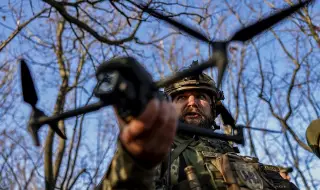
Russian soldiers are being tied to trees and abandoned as victims of Ukrainian combat drones - a practice called by the Russians themselves "victims of Baba Yaga". This is a form of punishment, filmed on video and distributed on social networks, applied to deserters and frightened fighters fleeing the front line. Drones from the Ukrainian army - especially the large combat models - are causing panic among Russians, who call them "Baba Yaga" - a fearsome witch from Slavic folklore, CNN reports.
Videos shot by Russian soldiers and intercepted radio communications confirm that commanders are ordering subordinates to be tied to trees in the combat zone, where they risk being killed by Ukrainian drones. In one of the videos, a soldier tied to a tree with a cable looks nervously at the sky as a voice behind the camera warns him that "it" - the drone - is coming and will "throw everything at him".
A commander of a Ukrainian drone battalion, known by the call sign Munin, confirmed to CNN that the practice is not an isolated case - he has personally observed such cases at least twice, and through radio reconnaissance has detected many more.
Beyond the violence on the front lines, social media reveals the despair of many Russian soldiers and their families. In one video, a former fighter, Yuri Duryagin, appeals to Vladimir Putin, telling how only 32 out of 150 men in his company in Donetsk survived due to a lack of equipment and ammunition. He received less than a fifth of his agreed salary, and killed comrades were often declared "missing" so that their families would not be paid compensation.
"I saw with my own eyes how my comrades died. Their parents were looking for information, but they were told that they were missing," he says. Duryagin even claims that his commander shot fighters who refused to attack.
According to the organization "Get Lost", founded by Grigory Sverdlin in Barcelona, violence is the "glue" that holds the Russian army together. The organization has helped more than 1,700 people defect since the start of the full-scale invasion. The Institute for the Study of War (ISW) estimates that the number of deserters in the Russian army may have reached 50,000.
Many of them give up before they are even sent to the front - after a minimum of one to three weeks of training. Survivors in the combat zone often describe a culture of indifference and cynicism, in which technology is valued more than human life.
"The officers say: 'You will be dead in a week, and I will get a new company'", says Sverdlin.
In another video, a soldier is tied to a tree with a rusty bucket on his head and then brutally beaten. In a third video, three men, nearly naked, are locked in a metal tank called an "animal holding tank." One of them is given a biscuit, which he quickly eats, while a voiceover humiliates him.