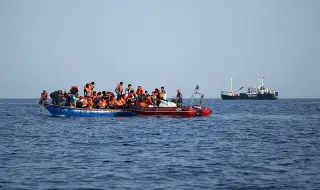
Good and bad migration news - this happened to Italian Prime Minister Giorgia Meloni in the same day. On August 1, she held a key meeting on her agenda, in which migration is among the top priorities, but just then her innovative migration approach encountered a new obstacle, summarize world agencies and Italian media, quoted by BTA.
On Friday, August 1, Meloni visited Istanbul for a mini-summit at the “Dolmabahçe“ Palace with Turkish President Recep Tayyip Erdogan and Libyan Prime Minister Abdel Hamid Dbeiba, recall Agence France-Presse, Associated Press, Reuters, DPA, Anadolu Agency and ANSA. During the meeting, one of the leading topics was migration in the Mediterranean. A related topic was stability in Libya.
“The three leaders discussed strengthening their cooperation in order to address common challenges, starting with the management of migration flows“, said a statement from the Italian Council of Ministers on the tripartite meeting. No further details were mentioned, ANSA and Agence France-Presse noted.
According to a statement from the Turkish presidency during the meeting, Erdogan insisted that multilateral coordination was needed to root out illegal migration at its root, Agence France-Presse noted. The Turkish leader stressed that long-term and sustainable solutions are needed in this direction to eliminate the causes of migration, the Associated Press adds.
The idea of these statements, which did not have many details, was clear - solutions must be found to the causes of migration, good conditions must be created in the migrants' home countries so that they do not embark on a journey from Africa across the Mediterranean to Europe and transit countries must be helped to cope with migration flows, global agencies summarize.
Libya occupies an important place on the migrant route. It is a country through which many migrants from Africa to Europe transit, note Agence France-Presse and the Associated Press. De facto Libya is even a dominant transit point for migrants fleeing wars and poverty in Africa. From the coast of Libya, migrants begin the dangerous journey across the Mediterranean to reach the nearest European destination. Most often, this is Italy or Greece, notes Agence France-Presse. Not only migrants from Africa pass through Libya, but also from the Middle East, where there are also conflicts and poverty, from which they want to escape. Often, the dangerous journeys from Libya to Europe end with the sinking of migrant boats. For example, in December, at least 61 migrants, including women and children, died when a migrant boat sank off the coast of the Libyan city of Zuwara, the Associated Press recalls.
The Libyan government of national unity has made commitments in the past to deter migration. In this regard, it has cooperation agreements with Europe and, in particular, with Italy. However, for Libyan efforts to be successful, the country must be politically stable, and Libya has not yet entered this phase. The North African country has been in chaos since the overthrow of Muammar Gaddafi's regime about 14 years ago, recalls Agence France-Presse, while the Associated Press recalls that the uprising that led to Gaddafi's overthrow was supported in 2011 by NATO. Libya is divided into two administrations - western and eastern. Each of them has its own government, its own leading figures and its own forces, notes the Associated Press. The western administration is the government of national unity of Dbeiba, while the eastern administration is dominated by Khalifa Haftar, defined as the strongman of the Libyan East, points out Agence France-Presse. This ongoing division is not at all helpful to the efforts of the authorities in Tripoli to combat illegal migration and deter migrants from leaving Libya for Europe.
International human trafficking networks are taking advantage of the instability in Libya. During the trilateral summit in Istanbul, the Italian prime minister stressed that the international community must support the actions of the Libyan government of national unity in the field of migration and in its fight against international trafficking networks, according to Agence France-Presse. Meloni recalled the excellent results achieved in the field of migration control by Italy in cooperation with Turkey and stressed that lessons must be drawn from these successes and the lesson learned from the joint work with Ankara must be applied to support the efforts of the Libyan government of national unity in the field of migration, added the Associated Press and ANSA.
In the divided Libya, Rome and Ankara are on the side of the Government of National Accord. In 2020, Turkey even sent military personnel to western Libya to train the military of the government in Tripoli, Reuters adds. However, this does not prevent them from establishing contacts with representatives of Khalifa Haftar for the purposes of joint efforts to combat migration flows. For example, in April, Khalifa Haftar's son - Saddam Haftar - visited Ankara. After which he visited Italy and the United States, recalls Agence France-Presse.
During the trilateral summit in Istanbul, Meloni confirmed Italy's commitment to the stability, unity and independence of Libya and expressed support for a Libyan-led and UN-facilitated political process that would lead to elections in the North African country, ANSA added.
At the end of the mini-summit in Istanbul, the three leaders agreed to meet again after trilateral meetings at a technical level, ANSA and the Associated Press noted.
Italy and Libya have a number of bilateral cooperation projects, the most important of which are in the field of energy. Turkey and Libya also have similar partnership projects. In 2019, Turkey reached an agreement with the Tripoli-based government, that is, with Libya's western administration, to demarcate the maritime borders between Libya and Turkey, which angered Cyprus, Greece and Egypt, which said the agreement violated their rights, the Associated Press and Reuters recall.
Separately, Italy and Turkey also have strong ties. An illustration of these strong ties is bilateral cooperation in the field of the defense industry, Reuters emphasizes. The Italian company “Leonardo“ and the Turkish company “Baykar“ announced in March that they would create a joint venture to produce drones, ANSA recalls. Ankara is also seeking to obtain 40 “Eurofighter Typhoon“ fighter jets from a consortium that also includes “Leonardo”, Reuters recalls. The total value of the fighters will be 5.6 billion euros. In order for the sale to take place, the approval of the four countries participating in the "Eurofighter" program is required, namely - Germany, Great Britain, Italy and Spain. In the general consortium producing the fighters, besides the Italian company “Leonardo“ also "Airbus" and "BAE Systems" participate. Negotiations in this direction have been underway since March 2023, and in the second half of July Turkey reached agreements with its NATO allies Britain and Germany, which pave the way for the purchase of these fighter jets, Reuters recalls.
While Meloni participated in the mini-summit in Istanbul, on August 1, the Court of Justice of the European Union issued a long-awaited decision regarding the notorious Italian plan to send certain categories of migrants intercepted in the Mediterranean to migration centers that Italy built in Albania, ANSA, France Press, Associated Press, Reuters and DPA reported.
In its decision of August 1, the Court of Justice of the EU did not challenge the right of an EU member state to designate a third country as a safe country of origin for migrants by means of a regulatory act. Meloni's government did something similar. Last year, it defined a list of 19 safe countries of origin for migrants by means of a regulatory act. According to the Court of Justice of the EU, however, the designation of a country as a safe country of origin must be subject to effective judicial review. For the purpose of such review, the sources on the basis of which a country was defined as a safe country of origin for migrants must be easily accessible to the judges carrying out this review. In addition, the Court of Justice of the EU considers that EU member states cannot designate third countries as safe countries of origin for migrants if for certain categories of migrants safety cannot be guaranteed there. For a country to be safe, it must provide safety to its entire population, the Court of Justice of the EU stressed. The Italian list of safe countries includes countries such as Bangladesh, Egypt and Tunisia, where the situation of minorities and opposition figures cannot be defined as safe, but rather is rather precarious, notes Agence France-Presse.
The Court of Justice of the EU's ruling came after the Italian authorities put into operation last autumn the migrant accommodation centres in Albania. Healthy male migrants intercepted in the Mediterranean by Italian authorities were sent there. In these centres, the migrants' identities and ages were checked. From these centres, they submitted applications for asylum in Italy, which were examined by the Italian authorities under an accelerated procedure. In the event of asylum being refused, the migrants were to be repatriated from the centres in Albania to their countries of origin, if these countries were on the Rome list of 19 safe countries.
However, things did not go smoothly under this so-called “Albanian-Italian scheme“, because Italian courts blocked the decisions of the Italian authorities to send migrants to Albania three times and ruled that the migrants already sent there should be immediately returned from Albania to Italy. Then came the referral to the Court of Justice of the EU. This referral stemmed from the case of two Bangladeshi migrants, rescued by the Italian authorities in the Mediterranean Sea, taken to centers in Albania, from where they filed asylum applications, which were examined under the fast-track procedure and which were rejected, recall Reuters, DPA and Agence France-Presse. The two Bangladeshis claim that their applications were rejected by Italy precisely because Bangladesh is among the 19 defined by Rome as safe countries of origin for migrants. After the EU Court of Justice's ruling on August 1, Dario Belluccio, a lawyer for one of the two Bangladeshis, said it "killed the Italian scheme to send migrants to Albania," Reuters reported.
Meloni presented the scheme as a cornerstone of her tough approach to illegal migration. Other European countries also saw the scheme as a role model, Reuters reported. In this regard, ANSA reports that despite the obstacles facing the scheme so far, it has won good reviews internationally and many leaders have praised it as an innovative way to dissuade migrants from entrusting their fate to traffickers who will ultimately take them not to the dreamed-of EU, but to a migration center in a non-EU country.
With the rise of the right in the EU, many European countries have adopted a tougher approach to migration, DPA noted. Some EU member states are also considering the idea of migrant centres in countries outside the EU, where migrants whose asylum applications in the EU have been rejected would be housed.
The ruling by the European Court of Justice has angered the Italian government. A statement from Meloni's office said the ruling allowed national judges to dictate migration policy, further reducing the already limited powers of parliament and government, Reuters and ANSA reported. "This development should be a cause for concern for everyone," the text added. The statement added that the ruling by the European Court of Justice weakened policies to combat mass illegal migration and protect national borders, DPA and ANSA reported. "Once again, the judiciary, this time the European one, has appropriated powers that do not belong to it," the government statement said, emphasizing that, in its view, the ruling of the Court of Justice of the EU usurps the responsibilities that are inherent to those who define policies for action.
The Italian government's statement said that the ruling of the highest European court grants national courts the right to decide what the country's migration policy regarding the expulsion of illegal migrants should be. National judges are also entrusted with the mission of deciding which country is safe or not, after such decisions have already been taken by the authorities on the basis of a complex study and assessment carried out by the relevant ministries and also submitted to the assessment of the Italian parliament, ANSA recalls.
The statement of the government in Rome commented that it was strange that the Court of Justice of the EU had taken such a decision several months before the European Pact on Migration and Asylum, which contains stricter rules in the field of migration, including those on the criteria for determining which countries of origin of migrants are safe, entered into force in the Union. It recalled that the Pact is the result of joint work by the European Commission, the European Parliament and the Council of the EU, ANSA adds. It will take effect in 10 months.
“The Italian government will not stop looking for all possible solutions, technical and regulatory, to protect the security of its citizens,“ the statement said.
The deal on the migration centers in Albania has long been criticized by human rights and migrant rights organizations and by the Italian opposition parties "5 Star Movement", "Green Left Union" and the Democratic Party. Regarding the decision of the EU Court, the leader of the Italian Democrats, Ellie Schlein, said that it shows that the government acted illegally and that it must now take responsibility for not having read Italian and European laws and for having "taken an illegal decision on the inhumane centers in Albania that trample on the fundamental rights of migrants and asylum seekers, wasting 800 million euros of Italian taxpayers", ANSA reported. The amount mentioned by Schlein is an estimate and is for the five-year period during which Italy's agreement with Albania on migrant centers on Albanian territory should be in effect. According to some estimates in Italy, this amount could swell to 1 billion euros if the cost of the ship transporting migrants to Albania is included in the five-year cost column, notes “Messagerro“. The Italian government itself mentions a total cost of 650 million euros over five years, recalls “Sole 24 Ore“.
The EU Court of Justice issued its decision a few days after the publication of a report on the costs incurred so far on the migrant centers in question in Albania, reports the Italian publication “Internationale“. The report is the work of the human rights organization “Action Aid“, in collaboration with the University of Bari. For the purposes of the report, data was collected on all active Italian centers for accommodating migrants who will then be deported. Based on this data, the authors of the report found that the two centers on Albanian territory are “the most expensive, inhumane and inefficient in the history of Italian migration policy“.
According to the report, in 2024 the centers in Albania were active for only five days, with the costs for these five days of activity amounting to 114,000 euros per day. This means that a total of 570,000 euros were paid for five days to cover the costs of running the centers. The document explains that its authors analyzed data on the costs of the centers in Albania until the end of March this year, before the Italian authorities decided to expand their status and turn them into centers for the repatriation of asylum seekers whose applications had already been rejected in Italy and who had been transferred from Italy to Albania.
The report said that 74.2 million euros were spent on the construction of one of the two centers in Albania - the one in Jadra with a capacity of 400 places. This means that the government paid over 153,000 euros for each place in the center. For comparison, in 2024 The construction of a similar center in Porto Empedocle, Italy, cost 1 million euros and provided 50 places for migrants, costing around 21,000 euros per place.
At the end of 2024, 11 migrant reception centers were operating in Italy. They had a total of 1,522 places to accommodate them, the report said. This was in addition to 1,033 places in three new centers for holding asylum seekers from countries considered safe and subject to an accelerated procedure for examining their asylum applications. This brings the total number of places available in the various centers to 2,555. Two of these new centers for asylum seekers were built in Sicily, between Modica and Ragusa, and in Porto Empedocle. And the third is in Jadra, Albania.
The report also notes that since 1998, more than 230,000 migrants have passed through repatriation and detention centers in Italy. And last year alone, housing migrants in detention centers and maintaining these centers cost the Italian state almost 96 million euros, which is more than it spent in this direction in the previous 6 years, the document also says. It also recalls that only 10 percent of migrants with rejected asylum applications were repatriated from Italy last year.
The positive in the statistics on the migration front in Italy was highlighted by Reuters. Although the “Albanian-Italian scheme“ has encountered legal problems, Italy's overall efforts have led to a decrease in the number of illegal migrants arriving by sea. Since the beginning of the year, only 36,557 migrants have arrived in Italy this way, which is significantly less than the number of migrants who arrived in the same period two years ago - 89,165.