


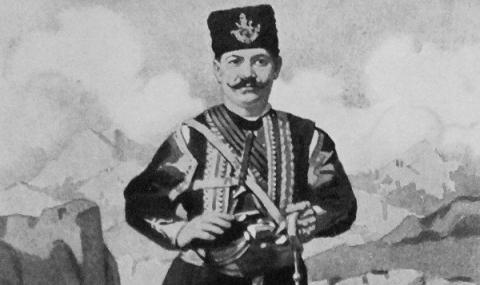

On February 7, 1900, Captain Petko Voevoda dies in Varna.
He was born as Petko Kiryakov on December 6, 1844 in the village of Doganhisar /present-day Greece/. He became an outlaw at only 16 – years old after the Turks slaughtered his older brother Mate and his cousin Valcho in front of his eyes. The numerous violence and arbitrariness of the Ottoman enslavers quickly turned the young man from a personal avenger into a defender of the rights of all the poor – Bulgarians, Greeks and Turks.
Soon the name of the youngest Rhodope voivode spread from mouth to mouth, and the bold and unexpected raids of Petkov's detachment made the beys and pashas tremble with horror. The head of the fearless voivode was valued at 10 thousand groschen, but he remained elusive to the hunters, recalls the Haskovo info website.
The fame of Petko Kiryakov spread throughout the entire Aegean Sea and reached Greece. In the autumn of 1864, the Greek committee, which was preparing an uprising for the liberation of the island of Crete, invited the legendary voivode to Athens. Here he spent the winter as a listener at the local military school, where he studied military affairs. Determined to help the Cretan rebels, Captain Petko went to the island of Capri to seek assistance from the great Italian patriot Giuseppe Garibaldi. At the head of a small detachment of Garibaldi and Bulgarian volunteers, Petko Voivode fought for the freedom of Crete, but the failure of the uprising forced him to return to the Rhodope Mountains.
Here in 1873 he created the first Bulgarian – Rhodope detachment “Protection”, which had its own democratic statute and internal regulations similar to the Greek and Garibaldi detachments. As article 1 in the statute it was written that the purpose of the organization was “to morally defend the Bulgarian people, suffering under the Turkish yoke, and to help in every way for its development – religiously and politically”. A large part of the fines that the voivode imposed on the Turkish nobles for their lawlessness were donated to churches, schools and to help the poor.
With the advance of the Russian troops to the south in 1878 and the capture of Plovdiv, Captain Petko's 300-member detachment liberated a number of Bulgarian and Greek villages, as well as the Greek city of Maronia. It was declared a republic and for three months was governed as a free settlement in defiance of the provisions of Constantinople, under whose authority it remained according to the San Stefano Peace Treaty. Soon, however, the Rhodope voivode's detachment had to leave the Aegean Sea to help the Bulgarians from Eastern Rumelia, who were rebelling against the decisions of the Berlin Congress that were ruining Bulgaria. Both in the entire vassal region of Turkey and everywhere in Haskovo, "Unity" committees sprang up. They were preparing to give a serious resistance to the Turkish troops and especially to the Bashibazouk gangs, who were harassing the population in the so-called "neutral zone" and along the still undetermined border. Because of the growing threat, the Haskovo Committee sent a man to the voivode to ask for help. Captain Petko replied to the envoy Anton Popov that if necessary, his detachment would not be late, but that the most important thing was for the Haskovo people to prepare better for resistance. The voivode himself toured the region, monitored the armament and digging of trenches, attacked the rebellious villages - strongholds of the Bashibazouk rebels. Soon a new envoy of the Haskovo Committee arrived with a letter, asking the legendary comitato to immediately come to the city with his detachment. In mid-March 1879, Captain Petko arrived in Haskovo to prepare the population for the expected attack by the Kardzhali, who were just waiting for the Russian troops to withdraw, to invade the surrounding area and devastate it.
The voivode ordered all village leaders to organize the construction of trenches along the border and in the villages and to provide him with data on the topography of the district, the rebellious villages and the approximate number of Muslims who would support the Turkish invasion. The closer the deadline for the withdrawal of the Russians approached, the more letters Captain Petko received from nearby villages.
In them, the villagers constantly asked him to send them ten - twenty or fifty fighters to help them, to protect themselves from the rampaging bashibazouks and rebels. After several battles with the people's protector's detachment, the enemy's heroism quickly evaporated - the mere presence of the voivode, famous in half of Europe, in Haskovo had a calming effect on them.
Feared by the uprising of the Bulgarians, the sultan accepted Russia's proposal not to send troops to Eastern Rumelia. This decision was certainly influenced by the tireless activity of Petko, the voivode in Thrace. He remained in Haskovo until the end of May, when he disbanded his detachment and was sent away with enthusiasm and gratitude from the local population.
The legendary freedom fighter died on February 7, 1900 in Varna in poor health, tortured and persecuted by the Stambolovists and traitors of Bulgarian national interests, against whom he fought tirelessly until the end of his life. However, Captain Petko remained in the hearts of the people forever.
To this day, a monument to the great voivode stands in the center of Haskovo, before which grateful descendants bow their heads every year.
On the occasion of the 160th anniversary of the voivode's birth on December 2, 2004, another monument to him was unveiled on the Gianicolo hill in Rome (authored by Professor Valentin Starchev), alongside that of Giuseppe Garibaldi.
On Livingston Island, Antarctica, a peak named Petko Voyvoda Peak was named after the distinguished Bulgarian.