


Today, Anton Pavlovich Chekhov would be called a highly effective person: a writer with a medical education who masterfully combined two jobs and devoted his free time to charity. During his 44 years, he created more than 300 works, managed to cure about a thousand people, planted hundreds of trees and performed dozens of good deeds. Chekhov went down in history as one of the creators of the new drama, causing a revolution in literature.
Anton Chekhov wrote his first short plays and essays while still studying at the gymnasium in his native Taganrog. At the age of 19, he moved to Moscow and entered the medical faculty of Moscow University. Shortly before this, Chekhov's family went bankrupt and the student was forced to combine studies with work. Literary publications brought him a small income. Chekhov published his stories and feuilletons in humorous magazines and did not suspect that years later he would form the basis of the new drama.
Over the centuries, most plays have been based on principles dating back to ancient tragedy and the works of Aristotle. The rule of three unities is considered to be the basis: action (the play must have one main plot, secondary ones are not important), time (the action should not take more than 24 hours) and place (all events take place strictly on stage, the place does not change). However, by the end of the 19th century, traditional forms, both in literature and in theater, had been exhausted. Chekhov also felt this.
Chekhov changed the approach to creating plays, their structure and found new artistic methods. In classical plays, the characters are divided into positive and negative, but he does not draw a line between good and evil, does not praise or blame his characters, but makes their images humane. Most of Chekhov's characters are people with internal conflict, with weaknesses and contradictions, dreamers, disappointed, full of passion and hope.
Traditional drama carried an element of edification, but Anton Chekhov abandoned this. His plays are based on reflection, analysis of the inner state of the characters. He filled the drama with anguish, contemplation and the search for answers to questions. He believed that everything on stage should be natural, as in real life, and paid great attention to the details in the dialogues and stage directions. The key events in Chekhov's plays often take place not on stage, but off it - in "The Seagull" the audience only hears Treplev fire the bullet, nor do they see the cherry orchard being cut down in the play of the same name.
Anton Chekhov continued to treat patients even after he became famous in literary circles. He combined work as a doctor and writing for decades, until the last years of his life. Today, Chekhov would be called a master of time management - his day was planned almost to the minute.
At the age of 32, the playwright bought the Melikhovo estate near Moscow, where he moved his parents, brother, and sister. While living there, Chekhov would get up at five in the morning, see patients, and tend to flowers.
He would have breakfast with his family at eight in the morning, then write and read medical articles. Lunch was at the usual time, after which Chekhov would teach the servants to read and write, and work on stories and plays. Then he could sleep or do housework, work in the vegetable garden and receive locals and guests.
“Every passing intellectual finds it necessary to stop by and warm up, and sometimes even stay overnight“, the playwright wrote in 1892.
Chekhov spent seven years intermittently in Melikhovo — treating residents of nearby villages, creating 42 works, including “The Seagull“, planting 80 apple trees, 60 cherry trees and dozens of other trees, including spruce and pine. The writer Tatyana Shchepkina-Kupernik noted: “The flowering of fruit trees evoked in him some joyful associations - perhaps of the gardens of his childhood in the southern city“.
Chekhov was so active that in the last years of his life he was literally prescribed a rest. "Recently I have been considered sick, the doctors have prescribed me idleness— and I am trying to follow this instruction, I am trying not to write", Chekhov reported in 1897.
Chekhov would probably be a volunteer and the author of all kinds of social initiatives today. He was a progressive, caring person, committed to solving other people's problems and trying to fight all kinds of injustice.
Chekhov treated and supplied the villagers with medicines free of charge, participated in public education and built schools. During the cholera epidemic, he became the "local doctor" for 25 villages in the vicinity of Melikhovo and made daily rounds. He participated in the construction of a highway in the Moscow region, organized the planting of forests and gardens, interceded for fast trains to stop in Lopasnaya (now the city of Chekhov), opened a post and telegraph office there. In his native Taganrog, he built a public library, to which he donated thousands of books.
In 1890, Chekhov began his most famous charitable mission. He went to Sakhalin Island, the place of exile for prisoners sentenced to hard labor. The journey there through Siberia took him 82 days. The writer visited prisons and talked to prisoners, including those who were exiled for political reasons, despite the fact that the administration forbade him. Chekhov collected documentary materials about the life and work of the exiles, observed how local authorities behaved, and described bureaucratic arbitrariness in his notes. He also conducted a population census.
If Chekhov were alive today, he would most likely create a video blog, make a documentary, or record a podcast about true crimes based on conversations with prisoners. But he put his impressions and travelogues into the book “Sakhalin Island“. Thanks to this, the public learned about what was happening on the island and was filled with sympathy, and the Ministry of Justice and the Main Directorate of Prisons sent their inspectors to Sakhalin to restore order.
Nowadays, Chekhov would share secrets on social networks on how to be more productive, would post photos from the garden and would certainly talk about his pets. Anton Chekhov loved animals since childhood, especially dogs - he attached great importance to their lives, treated them with respect and made them his heroes, just remember “Kashtanka“, “The Lady with the Dog“, “Chameleon“. In the 19th century, pets were more often kept for practical reasons - to help with hunting, to guard the house and owners, and to catch mice. But Chekhov, like many people today, simply adored his pets, played with them and considered them part of the family. At the same time, the writer even affectionately called his wife Olga Knipper "dog" in his letters: "My dear, angel, my dog, please believe that I love you, I love you deeply. Do not forget me, write and think of me more often." (1901).
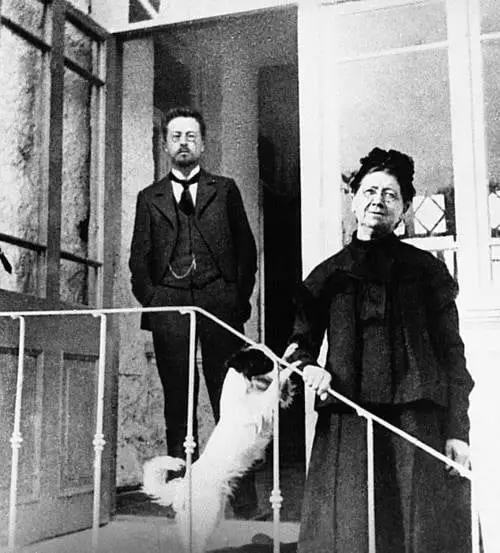
The playwright owned two dachshunds, named Brom and Hina, in honor of the medicinal preparations popular in those years. Chekhov often spoke of them in letters to friends and mentioned them in his notebooks. His nephew Mikhail Chekhov recalled: “He spent a whole half hour with this dog [Hina] in conversations that made everyone in the house die of laughter. Then it was Brom's turn. He put his front paws on Anton Pavlovich's knee and the fun began again.
Anton Chekhov had exotic animals. Returning from Sakhalin, the writer bought mongooses that he had never seen before. One of them was called Bastard, an unpleasant nickname invented by the sailors of the ship on which Chekhov was sailing. The writer named the other mongoose, “with very cunning, deceitful eyes“, Viktor Krylov — in honor of the playwright he disliked. “The third, female, timid, discontented and always sitting under the washbasin, is called Omutova“, Chekhov wrote, naming her after the actress from the Russian Drama Theater.
The wild animals lived in Melikhovo for more than a year, but turned out to be so hyperactive that they had to be placed in a zoo.
Author: Darya SHATALOVA, TASS