


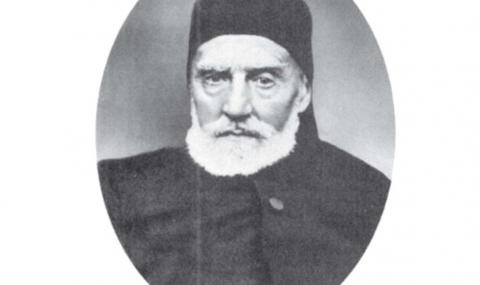

On August 1, 1859, the Ottoman statesman and Bulgarian Renaissance man Stefan Bogoridi died. He is one of the few Bulgarians for whom there is written evidence that he fought against Napoleon.
The real name of Prince Stefan Bogoridi is Stoyko Tsonkov Stoykov. He was born in Kotel. The year of his birth is disputed - 1775 or 1780.
Bogoridi was a senior Ottoman statesman, grandson of Sophrony of Vrachanski and father of Prince Aleko Bogoridi and Prince Nikola Bogoridi. The name Bogoridi was given to him and his brother Atanas in honor of Prince Boris I the Baptist, also known as Bogoris. Stefan Bogoridi studied at the Greek College in Bucharest, where he changed his birth name to Stoiko with the Greek Stefan. After teaching for a while in a Phanariot family in Istanbul on the recommendation of his grandfather Sophrony of Vratsa, Stefan Bogoridi joined the Ottoman navy as a translator and participated in Mustafa Pasha's corps against the French corps of Napoleon Bonaparte that had landed in Egypt. In the battle against the French, the Ottoman forces suffered a crushing defeat and Stefan Bogoridi miraculously managed to escape.
In 1812 Stefan Bogoridi went to Moldova and became governor of Galati. During the Wallachian Uprising, he was nominal kaymakam of Wallachia. The following year, he was kaymakam of Moldova, and then became a dragoman in the Ottoman navy. For three years, Stefan Bogoridi was sent into exile in Izmit, Asia Minor.
After the Russo-Turkish War (1828-1829) and the subsequent Treaty of Adrianople, Stefan Bogoridi headed the Ottoman delegation to St. Petersburg, which was to settle the disputed issues with Russia. He successfully coped with the mission and won the trust of Sultan Mahmud II, who appointed him as his advisor. For 30 years, Stefan Bogoridi participated in all major and important negotiations and decisions of the Sublime Porte, one of which was to determine the status of the Danubian Principalities. The English ambassador to Constantinople, Canning, recounts in his memoirs how, thanks to the diplomatic mission of Stefanaki Bey, Greece gained its independence.
In 1830, several prominent Bulgarians from Bucharest developed a project for an autonomous Bulgarian principality in Dobrudja. Prince Stefan Bogoridi was also familiar with it, and he tried to present the idea to the Turkish authorities, but without success. For Bogoridi's merits, Mahmud II gave him the title of prince /in Turkish bey/ and in 1834 appointed him governor of the island of Samos. Bogoridi, who renamed the island's main city after himself - Stephanoupolis, visited Samos only once and governed the island from Constantinople. His deputy in Samos was his personal secretary Gavril Krastevich. Bogoridi was hated by the local Greek population for his greed and dictatorial methods of governance. In 1849, the Samians rebelled against him and the Sultan overthrew him.
In 1850 After the mass peasant uprising in Vidin, Belogradchik, Kul and Lom regions, caused by the non-implementation of the agrarian reform in this region, the Sublime Porte, under the influence of Prince Stefan Bogoridi, carried out an administrative reform, forming a new administrative region from the three rebellious nahiyas. The implementation of the agrarian reform began, and Bulgarians had the opportunity to receive land.
Under Sultan Abdul-Mejid I, Stefan Bogoridi was a member of the Tanzimat Council and an imperial advisor, a position created especially for him. Stefan Bogoridi was the only Christian who, since the capture of Constantinople by the Ottoman Turks in 1453, had received a Turkish sultan in his house.
In August 1849, Stefan Bogoridi received permission from the Sultan to build a Bulgarian church in Constantinople and donated his house in the Fener quarter. Through voluntary donations, a small chapel was built, dedicated to Saint Stephen in honor of Stefan Bogoridi. The famous Iron Church was later built on the same site.
Stefan Bogoridi also maintained the Hellenic-Bulgarian school in his native Kotel and patronized many Bulgarian students, such as Gavril Krastevich and Georgi Rakovski, in their studies in Constantinople and abroad.